- English
- Chinese
- French
- German
- Portuguese
- Spanish
- Russian
- Japanese
- Korean
- Arabic
- Irish
- Greek
- Turkish
- Italian
- Danish
- Romanian
- Indonesian
- Czech
- Afrikaans
- Swedish
- Polish
- Basque
- Catalan
- Esperanto
- Hindi
- Lao
- Albanian
- Amharic
- Armenian
- Azerbaijani
- Belarusian
- Bengali
- Bosnian
- Bulgarian
- Cebuano
- Chichewa
- Corsican
- Croatian
- Dutch
- Estonian
- Filipino
- Finnish
- Frisian
- Galician
- Georgian
- Gujarati
- Haitian
- Hausa
- Hawaiian
- Hebrew
- Hmong
- Hungarian
- Icelandic
- Igbo
- Javanese
- Kannada
- Kazakh
- Khmer
- Kurdish
- Kyrgyz
- Latin
- Latvian
- Lithuanian
- Luxembou..
- Macedonian
- Malagasy
- Malay
- Malayalam
- Maltese
- Maori
- Marathi
- Mongolian
- Burmese
- Nepali
- Norwegian
- Pashto
- Persian
- Punjabi
- Serbian
- Sesotho
- Sinhala
- Slovak
- Slovenian
- Somali
- Scots Gaelic
- Shona
- Sindhi
- Sundanese
- Swahili
- Tajik
- Tamil
- Telugu
- Thai
- Ukrainian
- Urdu
- Uzbek
- Vietnamese
- Welsh
- Xhosa
- Yiddish
- Yoruba
- Zulu
- Kinyarwanda
- Tatar
- Oriya
- Turkmen
- Uyghur

Dacromet-Coated Hex Bolts
2026-10-27
1. Introduction
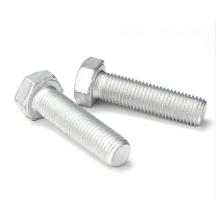
Every bolted joint is a battle against corrosion. A hex bolt (hexagon head cap screw) may be the most common fastener in the world, but once it is installed in a bridge, a transmission tower, or a chemical plant, it is immediately attacked by moisture, oxygen, chloride ions, and sulfur dioxide. Rust — first white rust (zinc oxidation products), then red rust (iron oxide) — creeps across the bearing surfaces, seeps into the threads, and eventually seizes the nut, weakens the clamp load, and destroys the joint.
Dacromet coating (also called DACROMET, zinc-flake coating, or non-electrolytic zinc-aluminum flake coating) was developed precisely to win this battle. It gives hex bolts, studs, and matching hex nuts and washers a thin, uniform, hydrogen-free armor that survives more than 700 hours of neutral salt spray (NSS) testing — several times the corrosion resistance of electro-galvanizing at the same thickness.
2. Fastener Basics: The Hex Bolt in a Bolted Joint
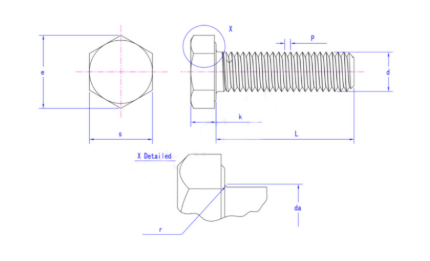
A hex bolt works with a nut (or a tapped hole) to clamp two or more parts together. The joint's integrity depends on the preload (clamp load) introduced during tightening, which is controlled by the applied torque, the thread pitch, and the friction coefficient (μ) between the bearing surfaces and the threads. In torque-controlled assembly, engineers convert the target preload into a torque value using the nut factor (K ≈ 0.12–0.16 for lubricated zinc-flake coated fasteners).
Typical mating components in a bolted assembly include:
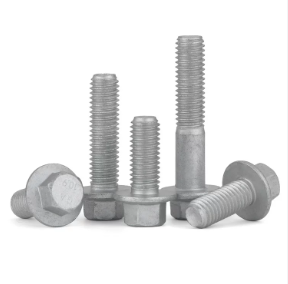
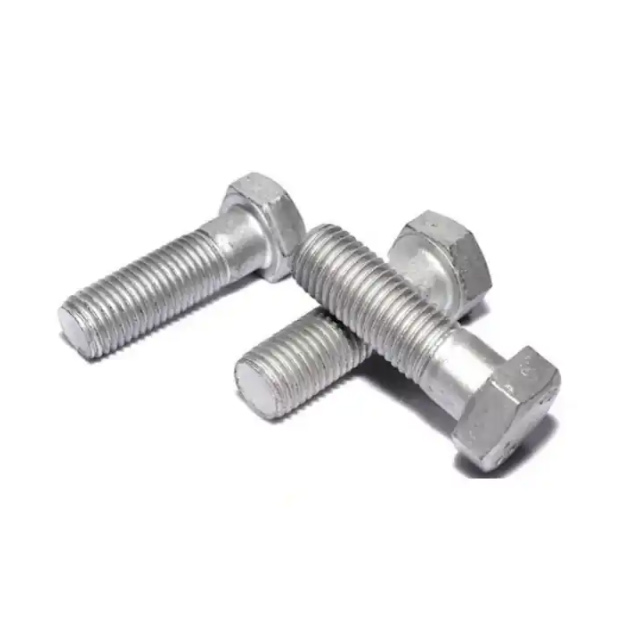
- Hex bolts / hex cap screws— full thread (DIN 933 / ISO 4017) or partial thread (DIN 931 / ISO 4014), property class 8.8, 10.9, or 12.9;
- Hex nuts— ISO 4032 standard nuts or ISO 4033 thin/jam nuts, class matched to the bolt;
- Flat washers(DIN 125) and spring washers (DIN 127) — distribute bearing load and add vibration resistance;
- Studs and threaded rods— for flanged connections and through-bolted assemblies;
- Flange nuts and flange bolts— with integral bearing flanges for soft substrates.
Each of these components must share the same corrosion-protection system; a Dacromet bolt paired with a plain zinc-plated nut creates a galvanic couple that sacrifices the nut first.
3. Corrosion Resistance: Dacromet vs. Other Bolt Finishes
Salt spray endurance (ISO 9227 / ASTM B117, hours to red rust) is the industry's benchmark for fastener corrosion protection.
| Finish / coating system | Thickness | Hours to red rust (NSS) | White rust (NSS) | Hydrogen embrittlement | Notes |
| Plain (self-color, oiled) | — | < 24 h | — | None | Indoor use only |
| Zinc plating, blue chromate (Zn3) | 5 μm | ≈ 48 h | 12–24 h | High | Low cost, consumer goods |
| Zinc plating, thick passivate (Zn12) | 12 μm | ≈ 192 h | 96–168 h | High | Not for class ≥ 10.9 |
| Mechanical galvanizing | 20–50 μm | 300–800 h | 200–400 h | Very low | Good for larger parts |
| Hot-dip galvanizing (HDG) | 45–85 μm | 500–1,500 h | 200–500 h | Low | Threads need re-tapping |
| Dacromet Class 2 | 8 μm | ≈ 720 h | 300–500 h | None | As-cut thread precision |
| Dacromet Class 3 / black | 10–12 μm | ≈ 1,000 h | 500–720 h | None | Automotive OEM benchmark |
Dacromet also outperforms zinc plating in the Kesternich test (SO₂ corrosion, ISO 6988 — industrial atmospheres and acid rain), in cyclic corrosion testing (CCT: combined salt spray / humidity / drying), in galvanic compatibility with aluminum substrates (thanks to the aluminum flake content), in temperature cycling (the inorganic film withstands 120–300°C service, where organic coatings blister), and in chemical resistance to road salts and de-icing chemicals.
4. Conclusion
For hex bolts and their mating hardware, Dacromet coating delivers the best balance of corrosion protection, mechanical precision, and assembly reliability available today: salt spray endurance up to 1,000 hours, immunity to hydrogen embrittlement, preserved thread geometry, and stable friction for torque-controlled assembly. Wherever a bolted joint must survive rain, salt, and time, the specification to remember is: high-strength hex bolt, zinc-flake (Dacromet) coated, ISO 10683 / ASTM F1136 compliant.