- English
- Chinese
- French
- German
- Portuguese
- Spanish
- Russian
- Japanese
- Korean
- Arabic
- Irish
- Greek
- Turkish
- Italian
- Danish
- Romanian
- Indonesian
- Czech
- Afrikaans
- Swedish
- Polish
- Basque
- Catalan
- Esperanto
- Hindi
- Lao
- Albanian
- Amharic
- Armenian
- Azerbaijani
- Belarusian
- Bengali
- Bosnian
- Bulgarian
- Cebuano
- Chichewa
- Corsican
- Croatian
- Dutch
- Estonian
- Filipino
- Finnish
- Frisian
- Galician
- Georgian
- Gujarati
- Hausa
- Hawaiian
- Hebrew
- Hmong
- Hungarian
- Icelandic
- Igbo
- Javanese
- Kannada
- Kazakh
- Khmer
- Kurdish
- Kyrgyz
- Latin
- Latvian
- Lithuanian
- Luxembou..
- Macedonian
- Malagasy
- Malay
- Malayalam
- Maltese
- Maori
- Marathi
- Mongolian
- Burmese
- Nepali
- Norwegian
- Pashto
- Persian
- Punjabi
- Serbian
- Sesotho
- Sinhala
- Slovak
- Slovenian
- Somali
- Samoan
- Scots Gaelic
- Shona
- Sindhi
- Sundanese
- Swahili
- Tajik
- Tamil
- Telugu
- Thai
- Ukrainian
- Urdu
- Uzbek
- Vietnamese
- Welsh
- Xhosa
- Yiddish
- Yoruba
- Zulu
- Kinyarwanda
- Tatar
- Oriya
- Turkmen
- Uyghur

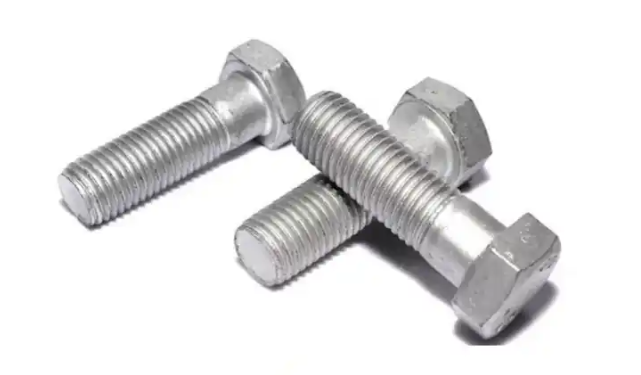
Dacromet-Coated Hex Bolts
2026-10-27
1. Introduction
Hex bolts (hexagon head bolts) are among the most widely used fasteners in construction, machinery, automotive assembly, and infrastructure. In corrosive environments — coastal structures, chemical plants, highways, bridges, and outdoor steel towers — the service life of a bolted joint is often determined not by the strength of the steel, but by the durability of its protective coating.
Dacromet coating (also known as DACROMET, Dacromet zinc-flake coating, or zinc-aluminum flake coating) is a water-based conversion-and-barrier coating applied by dip-spin or spray processes and cured at low temperature. Since its invention in the United States in the 1970s and its subsequent industrialization in Japan and Europe, Dacromet has become the mainstream corrosion-protection solution for high-strength bolts, particularly in grades 8.8 and above, where traditional hot-dip galvanizing carries hydrogen embrittlement risks and dimensional problems.
2. What Is a Dacromet-Coated Hex Bolt?
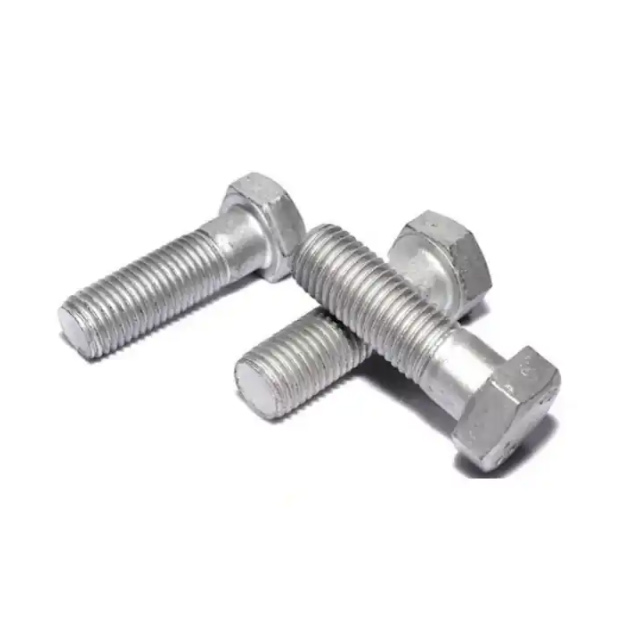
A Dacromet-coated hex bolt is a standard hexagon head bolt (per ISO 4014 / ISO 4017 / DIN 931 / DIN 933 or ASME B18.2.1) whose surface has been protected by a zinc-flake based coating applied from a water-based slurry containing:
- Zinc flakes and aluminum flakes— the active corrosion-protection barrier (typical ratio around 75% Zn / 25% Al by solid content);
- Chromium compounds or chromium-free passivators— provide self-healing passivation at scratch areas;
- Inorganic binders and cellulose thickeners— bond the flakes into a dense, adherent film;
- Deionized water— the carrying medium, making the process VOC-free and environmentally friendly.
The coating is applied by dipping (or spraying) followed by centrifugal spinning to remove excess slurry, then cured at approximately 280–330°C for 20–40 minutes. Multiple dip-spin cycles (typically two) build a coating thickness of 6–10 μm; heavier classes reach 12–15 μm.
Key Characteristics of the Dacromet Process
| Feature | Description |
| Curing temperature | 280–330°C (below the tempering temperature of grade 10.9/12.9 bolts) |
| Coating thickness | 6–15 μm (class-dependent), far thinner than hot-dip galvanizing (45–85 μm) |
| Hydrogen embrittlement | No acid pickling, no electroplating — virtually no hydrogen embrittlement risk |
| Hex head fit | Thin, uniform coating preserves thread geometry — bolts mate with standard taps and nuts |
| Environmental profile | Water-based, no VOC emissions; chromium-free (Cr³⁺/Cr⁶⁺-free) variants available |
| Electrical conductivity | Conductive film, suitable for grounding-critical structures |
Table 1. Key characteristics of the Dacromet coating process.
3. Corrosion Protection Mechanism
Dacromet protects the steel substrate through three complementary mechanisms:
1.Barrier effect— overlapping zinc and aluminum flakes form a laminated film with a tortuous path that dramatically slows the penetration of water, oxygen, and chloride ions.
2.Sacrificial protection— zinc is less noble than steel; at any scratch or cut edge, zinc corrodes preferentially and cathodically protects the exposed steel.
3.Passivation / self-healing— passivators form insoluble oxide films at damaged spots, "healing" minor scratches and delaying white rust and red rust formation.
The combination of these three mechanisms explains why Dacromet coatings routinely deliver 500–1,000 hours to red rust in neutral salt spray testing (per ISO 9227 / ASTM B117) at thicknesses of only 6–10 μm — several times the performance of equivalent-thickness electro-galvanizing.
4. Conclusion
Dacromet-coated hex bolts combine the mechanical strength of standard property classes 8.8–12.9 with a thin, uniform, hydrogen-safe, and environmentally friendly corrosion-protection system. With salt spray performance several times better than electro-galvanizing at a fraction of the thickness of hot-dip galvanizing, Dacromet has become the default specification for high-strength fasteners in demanding infrastructure, energy, and transportation projects.
For buyers and engineers, the key decision factors are coating class (thickness and NSS hours), chromate type (Cr³⁺ vs Cr-free), friction coefficient control, and compliance with ISO 10683 / ASTM F1136. A properly specified Dacromet hex bolt delivers predictable, long-term joint integrity — even in the harshest environments.