- Chinese
- French
- German
- Portuguese
- Spanish
- Russian
- Japanese
- Korean
- Arabic
- Irish
- Greek
- Turkish
- Italian
- Danish
- Romanian
- Indonesian
- Czech
- Afrikaans
- Swedish
- Polish
- Basque
- Catalan
- Esperanto
- Hindi
- Lao
- Albanian
- Amharic
- Armenian
- Azerbaijani
- Belarusian
- Bengali
- Bosnian
- Bulgarian
- Cebuano
- Chichewa
- Corsican
- Croatian
- Dutch
- Estonian
- Filipino
- Finnish
- Frisian
- Galician
- Georgian
- Gujarati
- Haitian
- Hausa
- Hawaiian
- Hebrew
- Hmong
- Hungarian
- Icelandic
- Igbo
- Javanese
- Kannada
- Kazakh
- Khmer
- Kurdish
- Kyrgyz
- Latin
- Latvian
- Lithuanian
- Luxembou..
- Macedonian
- Malagasy
- Malay
- Malayalam
- Maltese
- Maori
- Marathi
- Mongolian
- Burmese
- Nepali
- Norwegian
- Pashto
- Persian
- Punjabi
- Serbian
- Sesotho
- Sinhala
- Slovak
- Slovenian
- Somali
- Samoan
- Scots Gaelic
- Shona
- Sindhi
- Sundanese
- Swahili
- Tajik
- Tamil
- Telugu
- Thai
- Ukrainian
- Urdu
- Uzbek
- Vietnamese
- Welsh
- Xhosa
- Yiddish
- Yoruba
- Zulu
- Kinyarwanda
- Tatar
- Oriya
- Turkmen
- Uyghur

Hexagon Flange Bolts with Dacromet Coating: Geometry, Process, Performance and Assembly Guidance
2026-10-26
1. Introduction
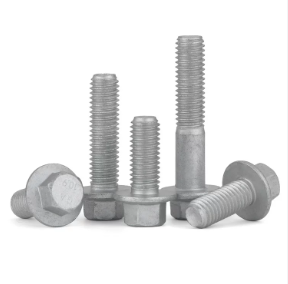
Flange bolts — hexagon head bolts with an integrated flange (washer face) built into the head — have become the fastener of choice in automotive manufacturing, machinery assembly, and pipeline construction. By combining the bolt and the washer into a single part, the flange bolt simplifies assembly, distributes the clamping load over a larger bearing area, and improves resistance to self-loosening under vibration.
In corrosive service environments, however, the benefits of the flange design can only be realized if the coating that protects the bolt survives as long as the joint itself. Dacromet (zinc-aluminum flake) coating has emerged as the preferred corrosion-protection system for high-strength flange bolts, offering salt spray resistance several times greater than electro-galvanizing at a fraction of the thickness of hot-dip galvanizing — and without any hydrogen embrittlement risk.
This article explains the geometry and standards of hex flange bolts, describes the Dacromet coating process as applied to flange bolts, presents performance comparisons and typical specifications, and offers practical selection and assembly guidance.
2. What Is a Hex Flange Bolt?
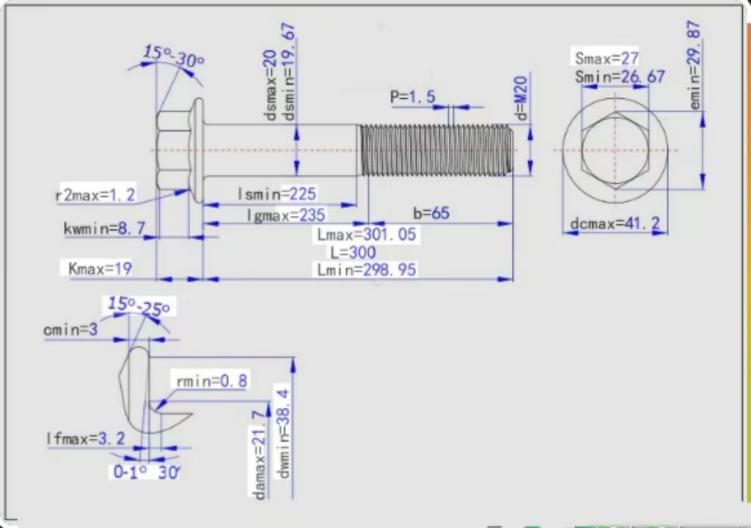
A hex flange bolt is a hexagon head bolt whose head carries an integral circular flange at the bearing surface, per ISO 4162 / DIN 6921 (metric) and comparable inch-series standards. Two design families exist:
- Small flange series— compact flange diameter for tight spaces, common in automotive engines;
- Large (wide) flange series— approximately 1.5 × thread diameter bearing surface, used where higher bearing loads or soft clamping materials (aluminum, plastics) are involved.
Many flange bolts additionally feature serrations (radial teeth) on the flange underside. The serrations bite into the mating surface, increasing the resistance to relative micro-movement and improving the bolt's resistance to self-loosening under transverse vibration — without needing a separate lock washer.
3. Why Dacromet Coating for Flange Bolts?
Dacromet coating is a water-based slurry of zinc and aluminum flakes with passivators and inorganic binders. Parts are dip-coated, centrifugally spun to remove excess slurry, and cured at 280–330°C for 20–40 minutes; two dip-spin cycles typically yield a 6–10 μm film. Flange bolts are particularly well suited to the dip-spin process:
1.Complete coverage— the coating flows into the flange-to-shank fillet and the serration grooves, areas where electroplating often leaves thin or irregular deposits;
2.Uniform thickness— centrifugal spinning gives even films across the flat flange face, preserving the parallel bearing surface that is critical for clamp-load accuracy;
3.No hydrogen embrittlement— no acid pickling or electrolytic current is involved, so grades 10.9 and 12.9 can be safely coated;
4.Thread precision— the thin, hard film preserves thread geometry, so flange bolts still run freely into tapped holes and mate with standard flange nuts;
5.Friction consistency— with integrated lubricant topcoats, Dacromet flange bolts achieve stable nut factors (K ≈ 0.12–0.16), essential for torque-controlled assembly lines.
4. Performance and Mechanical Advantages
Bearing area and surface pressure
The defining advantage of the flange design is load distribution. The table below compares a standard M10 hex bolt, a hex bolt with separate washer, and an M10 large-flange bolt at the same 30 kN clamp load.
| Bolt configuration | Bearing OD (approx.) | Bearing area (mm²) | Surface pressure at 30 kN (N/mm²) |
| Hex bolt DIN 933, no washer | 14.5 mm (washer face) | ≈ 78 | ≈ 385 |
| Hex bolt + flat washer DIN 125 | 20 mm | ≈ 166 | ≈ 181 |
| Hex flange bolt DIN 6921 | 21.5 mm | ≈ 208 | ≈ 144 |
Table 1. Bearing area and surface pressure comparison (M10 example, typical values).
Figure 2. Lower surface pressure means less embedding into soft or painted surfaces and a stiffer joint over time.
Lower surface pressure reduces embedding (brinelling) into aluminum or painted surfaces, keeps the clamped joint stiffer over time, and lowers the risk of the head sinking into soft materials. In addition, independent transverse-vibration testing (Junker test, DIN 65151) consistently shows that serrated flange bolts retain substantially more clamp load than plain hex bolts of the same grade, because the serrations lock the bearing interface and the wider flange resists head rotation.