- English
- Chinese
- French
- German
- Portuguese
- Spanish
- Russian
- Japanese
- Korean
- Arabic
- Irish
- Greek
- Turkish
- Italian
- Danish
- Romanian
- Indonesian
- Czech
- Afrikaans
- Swedish
- Polish
- Basque
- Catalan
- Esperanto
- Hindi
- Lao
- Albanian
- Amharic
- Armenian
- Azerbaijani
- Belarusian
- Bengali
- Bosnian
- Bulgarian
- Cebuano
- Chichewa
- Corsican
- Croatian
- Dutch
- Estonian
- Filipino
- Finnish
- Frisian
- Galician
- Georgian
- Gujarati
- Haitian
- Hausa
- Hawaiian
- Hebrew
- Hmong
- Hungarian
- Icelandic
- Igbo
- Javanese
- Kannada
- Kazakh
- Khmer
- Kurdish
- Kyrgyz
- Latin
- Latvian
- Lithuanian
- Luxembou..
- Macedonian
- Malagasy
- Malay
- Malayalam
- Maltese
- Maori
- Marathi
- Mongolian
- Burmese
- Nepali
- Norwegian
- Pashto
- Persian
- Punjabi
- Serbian
- Sesotho
- Sinhala
- Slovak
- Slovenian
- Somali
- Scots Gaelic
- Shona
- Sindhi
- Sundanese
- Swahili
- Tajik
- Tamil
- Telugu
- Thai
- Ukrainian
- Urdu
- Uzbek
- Vietnamese
- Welsh
- Xhosa
- Yiddish
- Yoruba
- Zulu
- Kinyarwanda
- Tatar
- Oriya
- Turkmen
- Uyghur

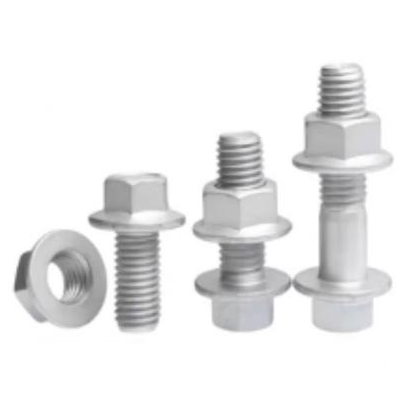
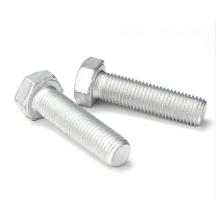
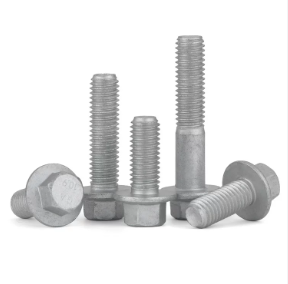
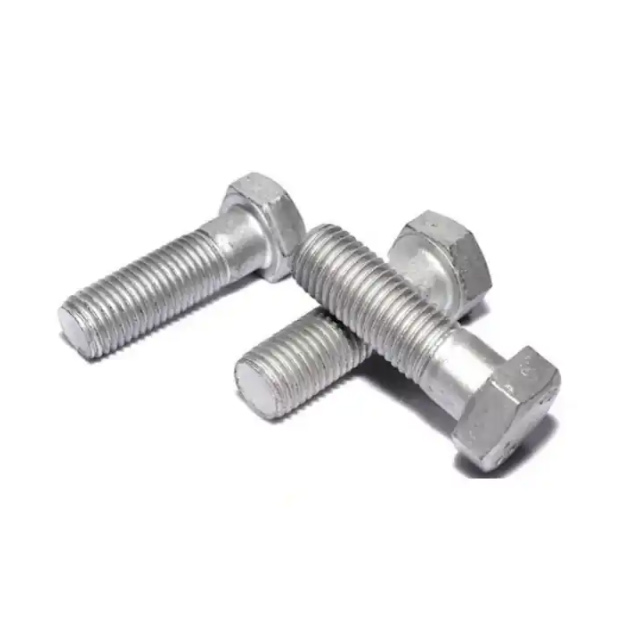
Dacromet-Coated Bolts and Nuts
2026-10-28
1. Introduction
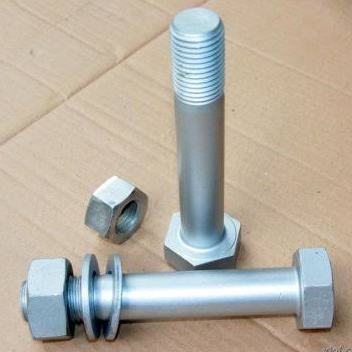
A threaded connection is only as strong as its weakest component. A premium Dacromet-coated hex bolt torqued into a cheap zinc-plated nut is not a corrosion-protection system — it is a galvanic cell waiting to fail. The zinc-plated nut becomes the anode in the couple, corrodes preferentially, seizes on the bolt threads, and the entire joint loses its clamp load long before the bolt itself shows any red rust.
For this reason, professional fastener specifications always treat bolts, nuts and washers as one matched corrosion-protection package. Dacromet (zinc-aluminum flake, non-electrolytic) coating is the system of choice for this package: it gives every thread — male and female — a thin (5–12 μm), uniform, hydrogen-free film that endures 500–1,000 hours of neutral salt spray (NSS) exposure without white rust breakout or red rust staining.
This article explains the fastener families involved, the corrosion mechanisms that attack threaded joints, why Dacromet suits bolts and nuts alike, and how to specify and assemble a matched bolt-nut-washer set.
2. How Corrosion Attacks a Threaded Joint
Threads are the most corrosion-vulnerable geometry on any fastener assembly:
1.Crevice corrosion— the microscopic gap between bolt thread flank and nut thread flank traps moisture and electrolyte, creating an oxygen-starved crevice where anodic sites form and pitting begins;
2.Galvanic corrosion— dissimilar coatings or metals (a Dacromet bolt with an electro-plated nut, a stainless bolt in a galvanized nut) drive preferential corrosion of the less noble component;
3.Coating damage at assembly— threads scrape and gall during tightening; thin electroplate and organic paints are easily cut through, exposing bare steel in the thread roots;
4.Stress concentration— the first load-bearing thread carries a disproportionate share of preload, so corrosion pits there rapidly become fatigue cracks;
5.Fretting under vibration— micro-movement between bearing faces abrades the film, inviting white rust and then red rust.
Once rust products build up in the threads, the nut seizes, disassembly torque exceeds installation torque, and the bolt or stud often has to be cut out — the classic "frozen nut" failure in field maintenance.
3. Corrosion Resistance of the Matched Set
| Coating system (bolt + nut + washer) | Thickness | NSS to red rust | Thread fit after coating | Hydrogen embrittlement | Relative cost |
| Plain / self-color, oiled | — | < 24 h | Excellent | None | Lowest |
| Zinc plate + blue chromate | 5 μm | ≈ 48 h | Good | High | Low |
| Zinc plate + thick tri-passivate | 8–12 μm | 120–240 h | Good | High | Low-medium |
| Mechanical galvanizing | 20–50 μm | 300–800 h | Good | Very low | Medium |
| Hot-dip galvanizing (nut re-tapped) | 45–85 μm | 500–1,500 h | Re-tapping needed | Low | Medium |
| Dacromet Class 2 (flZn 8) | 8 μm | ≈ 720 h | Excellent | None | Medium |
| Dacromet Class 3 / black | 10–12 μm | ≈ 1,000 h | Excellent | None | Medium-high |
Table 1. Coating systems for bolt-nut assemblies compared (typical industry values).
Because the coating is applied to finished, heat-treated parts and cured below the tempering temperature, both bolts and nuts keep their full mechanical properties — tensile strength, proof load and hardness per ISO 898-1 / ISO 898-2 — unchanged.
4. Assembly Best Practices
1.Never mix coating systems— pair Dacromet bolts only with Dacromet nuts and washers; a mixed couple drives galvanic corrosion of the weaker (usually zinc-plated) part;
2.Respect the torque table— lubricated Dacromet pairs have a lower, more stable nut factor than bare steel; reusing old torque values over-tightens and may strip the nut threads;
3.Do not re-lubricate— the integrated topcoat already sets the friction coefficient; additional oil on threads changes K unpredictably;
4.Mind the jam-nut order— when a thin nut and a full nut are stacked (classic locking arrangement), tighten the full nut against the thin nut;
5.Watch for gallingon stainless pairs — Dacromet's lubricant topcoat also reduces galling risk on stainless studs;
6.Verify first-article torque-tensionon a testing skid, using the actual bolt-nut-washer combination from the production lot.
5. Conclusion
Corrosion failure rarely starts on the shank of a bolt — it starts in the threads, in the crevice between the bolt and the nut. A durable joint therefore demands a matched corrosion-protection package: Dacromet-coated bolts, nuts and washers in the same zinc-flake system, specified together (ISO 10683 / ASTM F1136, flZn 8/10, ≥ 720 h NSS), assembled with the correct torque and friction values. The result is a threaded connection that resists white rust, red rust, pitting, crevice attack and seizure — through years of salt spray, weather and vibration.