- English
- Chinese
- French
- German
- Portuguese
- Spanish
- Russian
- Japanese
- Korean
- Arabic
- Irish
- Greek
- Turkish
- Italian
- Danish
- Romanian
- Indonesian
- Czech
- Afrikaans
- Swedish
- Polish
- Basque
- Catalan
- Esperanto
- Hindi
- Lao
- Albanian
- Amharic
- Armenian
- Azerbaijani
- Belarusian
- Bengali
- Bosnian
- Bulgarian
- Cebuano
- Chichewa
- Corsican
- Croatian
- Dutch
- Estonian
- Filipino
- Finnish
- Frisian
- Galician
- Georgian
- Gujarati
- Haitian
- Hausa
- Hawaiian
- Hebrew
- Hmong
- Hungarian
- Icelandic
- Igbo
- Javanese
- Kannada
- Kazakh
- Khmer
- Kurdish
- Kyrgyz
- Latin
- Latvian
- Lithuanian
- Luxembou..
- Macedonian
- Malagasy
- Malay
- Malayalam
- Maltese
- Maori
- Marathi
- Mongolian
- Burmese
- Nepali
- Norwegian
- Pashto
- Persian
- Punjabi
- Serbian
- Sesotho
- Sinhala
- Slovak
- Slovenian
- Somali
- Scots Gaelic
- Shona
- Sindhi
- Sundanese
- Swahili
- Tajik
- Tamil
- Telugu
- Thai
- Ukrainian
- Urdu
- Uzbek
- Vietnamese
- Welsh
- Xhosa
- Yiddish
- Yoruba
- Zulu
- Kinyarwanda
- Tatar
- Oriya
- Turkmen
- Uyghur

Dacromet-Coated Flange Bolts and Flange Nuts
2026-10-29
1. Introduction
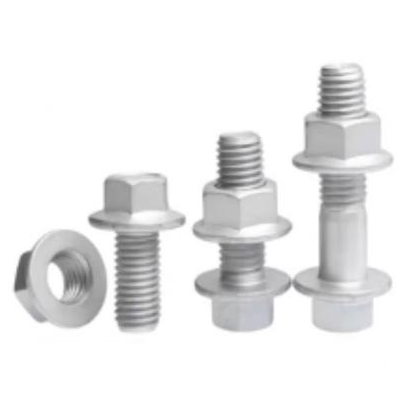
Every bolted joint is only as strong as its weakest partner. A high-strength flange bolt mated with an unprotected ordinary hex nut creates a galvanic couple, a corrosion trap, and a future field failure. This article introduces the matched pair — Dacromet-coated flange bolts (hex bolts with an integral flange under the head) and Dacromet-coated flange nuts (hex nuts with a rotating flange collar) — and explains why both members of the joint should carry the same zinc-aluminum flake coating.
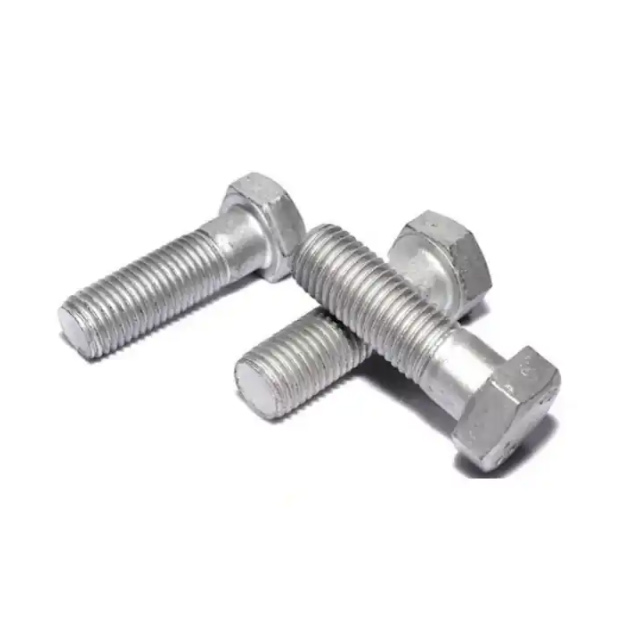
Dacromet coating — the non-electrolytic zinc-flake process defined by ISO 10683 and ASTM F1136 — delivers 700 to 1,000 hours of salt spray resistance (ASTM B117 neutral salt spray, NSS) to first red rust, in a thin 8–12 μm film, with no hydrogen embrittlement risk. Applied consistently to bolt and nut, it protects the entire threaded fastening system: the bearing surfaces, the flange faces, and the load-bearing internal and external threads.
2. The Two Components
2.1 Hex flange bolts
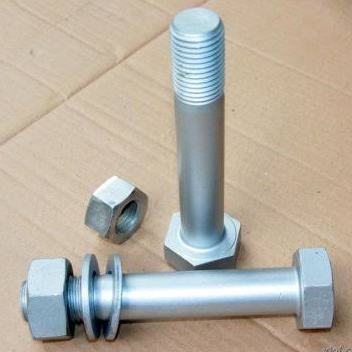
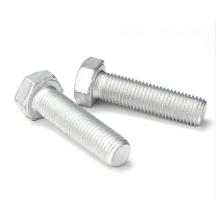
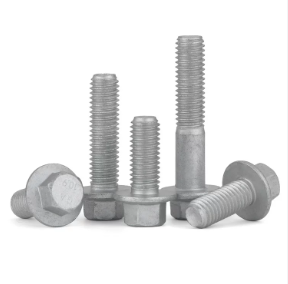
A hex flange bolt is a hexagon head bolt with an integrated circular flange (built-in washer face) at the under-head bearing surface, standardized in ISO 4162 / DIN 6921 and GB/T 5789 / GB/T 16674. Design options include:
- Small flange series— compact bearing diameter for confined bolt locations;
- Large (wide) flange series— bearing diameter of approximately 1.5 × d, which lowers surface pressure under the head and reduces embedding into soft materials such as aluminum castings;
- Serrated flange— radial teeth on the flange underside that bite into the clamped surface, increasing resistance to vibration-induced self-loosening without a separate lock washer.
3. Why the Matched System Matters for Corrosion Control
A zinc-flake-coated bolt running into a bare or electro-plated nut forms a galvanic couple: two dissimilar surfaces in contact with an electrolyte (rain, condensation, road salt). The less noble surface corrodes preferentially, generating white rust (zinc oxidation products) and eventually red rust (base-steel corrosion) at exactly the most critical location — the threads that carry the preload. Coating both bolt and nut with the same Dacromet system equalizes the corrosion potentials and removes the driving force for galvanic attack.
The Dacromet process involves no acid pickling and no electrolytic current, so no atomic hydrogen is introduced into the steel. This makes it the standard choice for high-strength flange bolts and flange nuts of property class 10.9 and 12.9, where hydrogen embrittlement (HE) failure of electro-plated fasteners is a documented risk.
4. Coating Performance Comparison
| Coating system (bolt + nut, class 8.8) | Typical thickness | Salt spray to white rust | Salt spray to red rust (NSS) | Hydrogen embrittlement |
| Electro-galvanized Zn5 | 5 μm | ≈ 24 h | ≈ 72–96 h | High risk |
| Electro-galvanized Zn12 | 12 μm | ≈ 72 h | ≈ 192 h | High risk |
| Mechanical galvanizing | 25–40 μm | ≈ 96 h | ≈ 400–500 h | Low |
| Hot-dip galvanized | 45–85 μm | — | ≈ 720 h | Low; threads need re-tapping, nut oversize |
| Dacromet DAC 320 (Class 2) | 8 μm | ≈ 240 h | ≈ 720 h | Virtually none |
| Dacromet DAC 500 / black | 10–12 μm | ≈ 480 h | ≈ 1,000 h | Virtually none |
A further assembly benefit: hot-dip galvanized nuts must be tapped oversize, which reduces the nut's effective shear area, whereas Dacromet-coated flange nuts retain standard 6H thread tolerance and full strength — the thin, hard film preserves thread fit, so bolts and nuts assemble freely with consistent friction and no galling of the coated surfaces.
5. Conclusion
Dacromet-coated flange bolts and flange nuts form an engineered fastening system: the flange geometry distributes clamp load, suppresses vibration loosening, and eliminates separate washers, while the matched zinc-aluminum flake coating on both members prevents galvanic couples, seals the crevice zones, resists white rust and red rust for 700–1,000 salt spray hours, and keeps high-strength steel free of hydrogen embrittlement. The single most important specification rule remains: order the bolts and the nuts as one matched, corrosion-protected system.