- Chinese
- French
- German
- Portuguese
- Spanish
- Russian
- Japanese
- Korean
- Arabic
- Irish
- Greek
- Turkish
- Italian
- Danish
- Romanian
- Indonesian
- Czech
- Afrikaans
- Swedish
- Polish
- Basque
- Catalan
- Esperanto
- Hindi
- Lao
- Albanian
- Amharic
- Armenian
- Azerbaijani
- Belarusian
- Bengali
- Bosnian
- Bulgarian
- Cebuano
- Chichewa
- Corsican
- Croatian
- Dutch
- Estonian
- Filipino
- Finnish
- Frisian
- Galician
- Georgian
- Gujarati
- Haitian
- Hausa
- Hawaiian
- Hebrew
- Hmong
- Hungarian
- Icelandic
- Igbo
- Javanese
- Kannada
- Kazakh
- Khmer
- Kurdish
- Kyrgyz
- Latin
- Latvian
- Lithuanian
- Luxembou..
- Macedonian
- Malagasy
- Malay
- Malayalam
- Maltese
- Maori
- Marathi
- Mongolian
- Burmese
- Nepali
- Norwegian
- Pashto
- Persian
- Punjabi
- Serbian
- Sesotho
- Sinhala
- Slovak
- Slovenian
- Somali
- Samoan
- Scots Gaelic
- Shona
- Sindhi
- Sundanese
- Swahili
- Tajik
- Tamil
- Telugu
- Thai
- Ukrainian
- Urdu
- Uzbek
- Vietnamese
- Welsh
- Xhosa
- Yiddish
- Yoruba
- Zulu
- Kinyarwanda
- Tatar
- Oriya
- Turkmen
- Uyghur

Dacromet Flange Bolts-Technical Overview
2026-08-20
содержание
1. Introduction
Dacromet flange bolts are high-strength fasteners that combine a flanged head design with an advanced zinc-aluminum flake coating known as Dacromet (also called zinc-chromium coating). The integrated flange under the head distributes clamping load more evenly, increases the bearing surface, improves resistance to vibration-induced loosening, and frequently eliminates the need for a separate washer.
Developed in the 1970s as a high-performance alternative to conventional electroplating and cadmium coatings, Dacromet technology has become a preferred surface treatment for Grade 8.8, 10.9 and 12.9 bolts. These fasteners are extensively used in automotive chassis and powertrain assemblies, wind-turbine structures, agricultural and construction machinery, chemical processing equipment, marine installations and outdoor steel infrastructure where long-term corrosion resistance is critical.
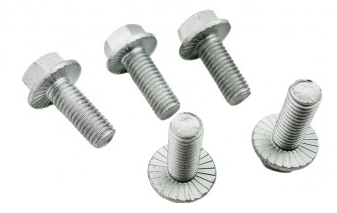
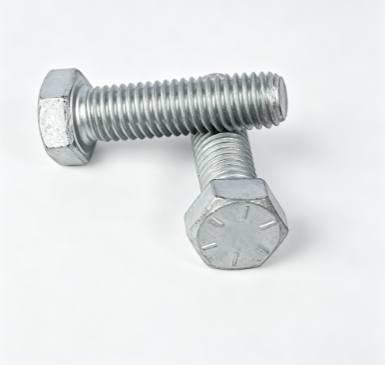
Figure A. Representative appearance of Dacromet-coated hex flange bolts (metallic silver-gray finish).
2. What is Dacromet Coating?
Dacromet is a non-electrolytic, water-based inorganic coating consisting of zinc flakes, aluminum flakes and chromium compounds (or modern chromium-free binders) dispersed in a specialized matrix. The coating is applied by dip-spin, spray or dip-drain methods and then thermally cured at approximately 300–320 °C. During curing a dense, multi-layered lamellar structure is formed that simultaneously provides barrier protection and sacrificial (cathodic) protection of the steel substrate.
Typical dry-film thickness ranges from 5 to 12 μm. Despite its thinness, the coating routinely delivers ≥1,000 hours (commonly 1,200–2,000 hours for optimized systems) of protection in neutral salt-spray testing (ASTM B117 / ISO 9227) before the appearance of red rust—approximately 7 to 10 times the performance of standard electro-galvanizing of comparable thickness.
3. Key Advantages
- Exceptional Corrosion Resistance: ≥1,000–1,500 h salt spray typical; high-performance variants exceed 2,000 h.
- Zero Hydrogen Embrittlement Risk: The process uses no acid pickling or electrolysis, making it safe for high-strength bolts (Grade 10.9+).
- High-Temperature Capability: Protective performance is retained up to approximately 300 °C.
- Excellent Dimensional Control: Thin uniform film preserves thread geometry; no need for oversized nuts.
- Flange Design Benefits: Even load distribution, reduced surface pressure and improved vibration resistance.
- Favorable Environmental Profile: Water-based chemistry with closed-loop application and reduced waste streams.
4. Performance Comparison with Traditional Coatings
|
Property |
Dacromet |
Electro-Galvanizing |
Hot-Dip Galvanizing |
|
Coating Thickness |
5–12 μm |
5–15 μm |
45–85 μm |
|
Salt Spray (to red rust) |
≥1,000–1,500 h |
100–300 h |
500–800 h |
|
Hydrogen Embrittlement |
None |
High risk |
Moderate risk |
|
Max. Service Temperature |
~300 °C |
~100–150 °C |
~200 °C |
|
Impact on Thread Fit |
Minimal |
Low |
Significant |
5. Manufacturing & Coating Process
The typical process sequence comprises: alkaline cleaning and degreasing; mechanical descaling or abrasive blasting (acid pickling is deliberately avoided); application of the zinc-flake slurry by dip-spin or spray; thermal curing at 300–320 °C; optional application of a lubricated or protective topcoat; and final cooling plus inspection. Two successive basecoat applications are frequently used to reach the required thickness and performance level. Critical controls include surface cleanliness, slurry viscosity, spin parameters, furnace temperature uniformity and final coating-weight verification.
6. Typical Applications
- Automotive & Transportation: Chassis, suspension, engine and brake-system fasteners exposed to road salt, humidity and thermal cycling.
- Wind Energy: Tower and foundation bolts for onshore and offshore turbines that must endure multi-year exposure to saline atmospheres with minimal maintenance.
- Agricultural & Construction Machinery: Equipment operating in environments containing moisture, fertilizers, soil abrasion and outdoor weathering.
- Chemical & Process Industry: Flange connections and structural fasteners in plants handling corrosive fluids or atmospheres.
- Infrastructure & Marine: Bridges, transmission towers, coastal structures, port equipment and offshore platforms.
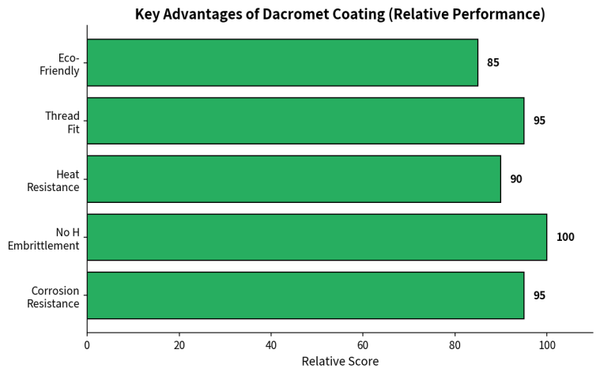
Figure 4. Relative performance strengths of the main Dacromet attributes.
7. Standards, Grades & Selection Guidance
Dimensional standards commonly referenced include DIN 6921 and ISO 4162 (hexagon flange bolts) together with equivalent national standards such as GB/T 5787. Mechanical property classes most frequently supplied with Dacromet coating are 8.8, 10.9 and 12.9 according to ISO 898-1. Coating performance is normally specified either by coating weight (Grade A ≈ 24 g/m², Grade B ≈ 36 g/m²) or by a minimum number of salt-spray hours. Many automotive OEM and structural specifications explicitly prefer zinc-flake systems for high-strength bolts precisely because they eliminate hydrogen-embrittlement risk.
Practical selection tips:
- Select the coating performance class according to the expected environmental corrosivity category (ISO 9223 C3–C5 or higher).
- For Grade 10.9 and above, specify Dacromet or an equivalent zinc-flake coating rather than conventional electroplating.
- When assembly torque accuracy or multi-tightening performance is important, request a controlled-friction topcoat (typical coefficient of friction 0.10–0.18).
- Handle and install the bolts carefully to avoid mechanical damage to the relatively soft coating film.
8. Conclusion
Dacromet flange bolts offer an excellent balance of high mechanical strength, long-term corrosion protection, dimensional precision and operational safety. By removing the risk of hydrogen embrittlement and delivering multi-year service life even in aggressive environments, they reduce maintenance costs and increase structural reliability across the automotive, renewable-energy, industrial and infrastructure sectors. Clear specification of the required mechanical grade, dimensional standard, coating performance class and any topcoat requirements ensures that the fasteners will perform as intended throughout their service life.