- Chinese
- French
- German
- Portuguese
- Spanish
- Russian
- Japanese
- Korean
- Arabic
- Irish
- Greek
- Turkish
- Italian
- Danish
- Romanian
- Indonesian
- Czech
- Afrikaans
- Swedish
- Polish
- Basque
- Catalan
- Esperanto
- Hindi
- Lao
- Albanian
- Amharic
- Armenian
- Azerbaijani
- Belarusian
- Bengali
- Bosnian
- Bulgarian
- Cebuano
- Chichewa
- Corsican
- Croatian
- Dutch
- Estonian
- Filipino
- Finnish
- Frisian
- Galician
- Georgian
- Gujarati
- Haitian
- Hausa
- Hawaiian
- Hebrew
- Hmong
- Hungarian
- Icelandic
- Igbo
- Javanese
- Kannada
- Kazakh
- Khmer
- Kurdish
- Kyrgyz
- Latin
- Latvian
- Lithuanian
- Luxembou..
- Macedonian
- Malagasy
- Malay
- Malayalam
- Maltese
- Maori
- Marathi
- Mongolian
- Burmese
- Nepali
- Norwegian
- Pashto
- Persian
- Punjabi
- Serbian
- Sesotho
- Sinhala
- Slovak
- Slovenian
- Somali
- Samoan
- Scots Gaelic
- Shona
- Sindhi
- Sundanese
- Swahili
- Tajik
- Tamil
- Telugu
- Thai
- Ukrainian
- Urdu
- Uzbek
- Vietnamese
- Welsh
- Xhosa
- Yiddish
- Yoruba
- Zulu
- Kinyarwanda
- Tatar
- Oriya
- Turkmen
- Uyghur

Dacromet Coating Bolts–A Comprehensive Guide to Zinc-Aluminum Flake Coating Technology for Fasteners
2026-07-14
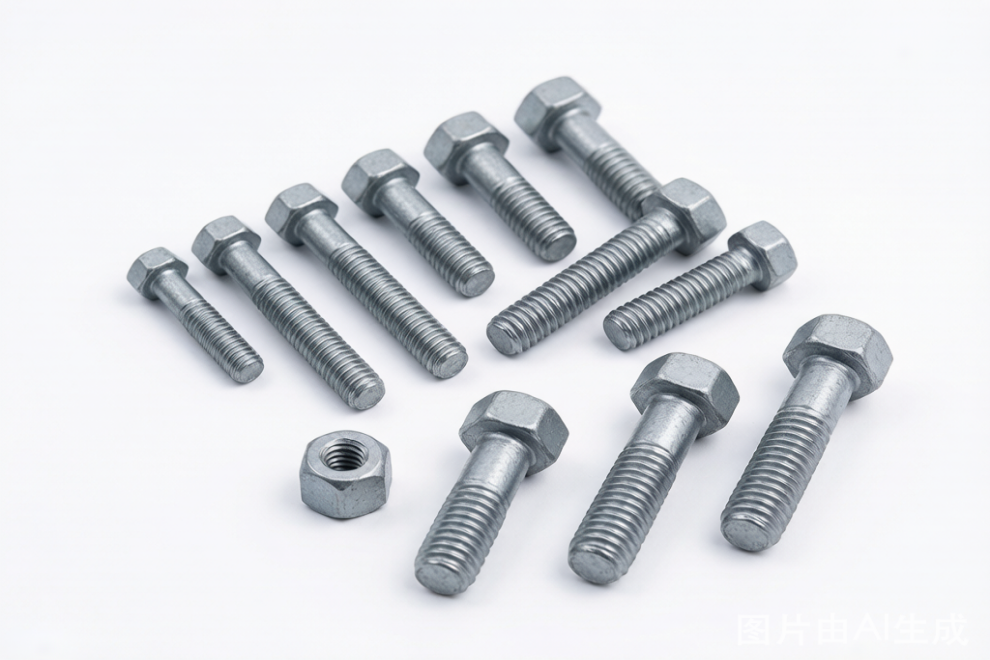
Dacromet (达克罗), also known as zinc-aluminum chromate coating, is a water-based, environmentally friendly surface treatment technology widely used on steel fasteners. Unlike conventional electroplating, Dacromet applies a thin film of overlapping zinc and aluminum flakes bonded by inorganic chromium compounds, delivering 500–1,200 hours of salt spray resistance without hydrogen embrittlement. This document provides a detailed overview of the Dacromet coating system — its composition, structure, process, performance, and applications in the fastener industry.
1.What Is Dacromet?
Dacromet was developed in the late 1960s by the American company Diamond Shamrock (later MCI, then NDS / Doerken MKS). Originally created to address hydrogen embrittlement failures in high-strength automotive fasteners, it has since become a globally recognized anti-corrosion coating standard, specified under ISO 10683, ASTM B695, and various national standards (GB/T 18684 in China).
Key Characteristics
Non-electrolytic process: Dacromet is applied via dip-spin coating, not electroplating. No electric current passes through the parts, eliminating hydrogen generation and the associated embrittlement risk.
Flake-based coating: The coating consists of microscopic zinc and aluminum flakes (20–60 nm thick) that overlap like roof shingles, creating a dense, multi-layered barrier.
Thin and uniform: Typical coating thickness is 4–10 µm — thin enough to preserve thread fit and dimensional tolerances, unlike thick hot-dip galvanizing.
Environmentally compliant: Modern Dacromet is free of hexavalent chromium (Cr⁶⁺), meeting RoHS, REACH, and ELV (End-of-Life Vehicle) directives.
Heat resistant: The inorganic coating withstands continuous service temperatures up to 250°C, making it suitable for engine bay and exhaust-adjacent fasteners.
2.Key Advantages
Superior corrosion resistance: 500–1,200 hours of neutral salt spray (NSS) per ISO 9227 — 5–10 times better than conventional zinc plating (96–240 hrs).
Zero hydrogen embrittlement: The non-electrolytic process eliminates hydrogen absorption, making Dacromet the preferred coating for high-strength fasteners (Grade 8.8–12.9) where electroplating is restricted or banned.
Excellent coating uniformity: Dip-spin coating covers recesses, blind holes, and complex geometries more uniformly than electroplating or hot-dip galvanizing. Thread crests and roots receive consistent coverage.
Thin coating, preserved tolerances: At 4–10 µm, Dacromet does not interfere with thread engagement or torque-tension relationships. No re-tapping of nuts is required, unlike hot-dip galvanized fasteners.
Heat resistance: The inorganic ceramic-like coating maintains its protective properties at temperatures up to 250°C (continuous) and 300°C (short-term), far exceeding organic coatings.
Environmental compliance: Free of Cr⁶⁺, compliant with RoHS, REACH, and ELV directives. The water-based coating liquid has low VOC emissions compared to solvent-based alternatives.
Good adhesion and wear resistance: The chemically bonded flake coating resists chipping, scratching, and handling damage better than conventional plating.
3. Comparison with Other Coatings
The table below compares Dacromet with the two most common fastener coating alternatives — electroplated zinc plating and hot-dip galvanizing:
| Property | Dacromet | Zinc Plating | Hot-Dip Galvanizing |
| Salt Spray (hrs) | 500 – 1,200 | 96 – 240 | 300 – 1,000 |
| Hydrogen Embrittlement | None | Risk (Grade 10.9+) | None |
| Coating Thickness | 4 – 10 µm | 5 – 25 µm | 45 – 85 µm |
| Cr⁶⁺ Free | Yes (modern) | Varies | Yes |
| Coating Uniformity | Excellent | Good | Variable (drainage) |
| Thread Fit Impact | Minimal (thin) | Low | Significant (thick) |
| Heat Resistance | Up to 300°C | Up to 200°C | Up to 250°C |
| Appearance | Silver-grey, matte | Blue-white / clear | Bright / spangled |
| Cost Level | Medium | Low | Medium |
Salt spray per ISO 9227 NSS. Hydrogen embrittlement risk applies to electroplated fasteners Grade 10.9 and above.
4. Applications
Automotive: Engine components, chassis fasteners, brake systems, suspension parts, and underbody hardware. Dacromet is specified by major OEMs (VW, Toyota, GM, Ford) for high-strength bolts (Grade 8.8–10.9) where hydrogen embrittlement must be avoided.
Construction & infrastructure: Steel structure connections, bridge hardware, tunnel fasteners, and concrete formwork ties exposed to humid and corrosive environments.
Electrical & power: Transmission tower bolts, switchgear hardware, and electrical enclosure fasteners requiring long-term outdoor durability.
Railway & transit: Rolling stock fasteners, track components, and signaling equipment hardware exposed to de-icing salts and atmospheric corrosion.
Marine & coastal: Dock and harbor hardware, offshore platform fasteners, and equipment in salt-laden atmospheres (supplemented with a sealer topcoat for maximum protection).
Wind energy: Tower flange bolts, nacelle hardware, and foundation anchor bolts requiring decades of maintenance-free corrosion protection.
Appliances & HVAC: Heat exchanger fasteners, furnace components, and outdoor unit hardware where heat resistance and corrosion protection are both required.
Summary
Dacromet is a proven, high-performance anti-corrosion coating technology for steel fasteners. Its unique zinc-aluminum flake structure, applied through a non-electrolytic dip-spin process, delivers 500–1,200 hours of salt spray resistance without hydrogen embrittlement — making it the coating of choice for high-strength bolts in the automotive, construction, and energy sectors. With its thin, uniform film, environmental compliance, and excellent heat resistance, Dacromet bridges the gap between low-cost zinc plating and expensive stainless steel, offering an optimal balance of performance, reliability, and cost for demanding fastener applications.