- English
- Chinese
- French
- German
- Portuguese
- Spanish
- Russian
- Japanese
- Korean
- Arabic
- Irish
- Greek
- Turkish
- Italian
- Danish
- Romanian
- Indonesian
- Czech
- Afrikaans
- Swedish
- Polish
- Basque
- Catalan
- Esperanto
- Hindi
- Lao
- Albanian
- Amharic
- Armenian
- Azerbaijani
- Belarusian
- Bengali
- Bosnian
- Bulgarian
- Cebuano
- Chichewa
- Corsican
- Croatian
- Dutch
- Estonian
- Filipino
- Finnish
- Frisian
- Galician
- Georgian
- Gujarati
- Haitian
- Hausa
- Hawaiian
- Hebrew
- Hmong
- Hungarian
- Icelandic
- Igbo
- Javanese
- Kannada
- Kazakh
- Khmer
- Kurdish
- Kyrgyz
- Latin
- Latvian
- Lithuanian
- Luxembou..
- Macedonian
- Malagasy
- Malay
- Malayalam
- Maltese
- Maori
- Marathi
- Mongolian
- Burmese
- Nepali
- Norwegian
- Pashto
- Persian
- Punjabi
- Serbian
- Sesotho
- Sinhala
- Slovak
- Slovenian
- Somali
- Scots Gaelic
- Shona
- Sindhi
- Sundanese
- Swahili
- Tajik
- Tamil
- Telugu
- Thai
- Ukrainian
- Urdu
- Uzbek
- Vietnamese
- Welsh
- Xhosa
- Yiddish
- Yoruba
- Zulu
- Kinyarwanda
- Tatar
- Oriya
- Turkmen
- Uyghur

Grade 8.8 Dacromet Hex Bolt –IN 933 | ISO 4014 | Full-Thread Hexagon Bolt with Dacromet Anti-Corrosion Coating
2026-07-06
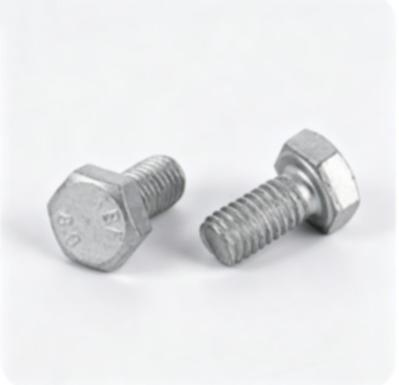
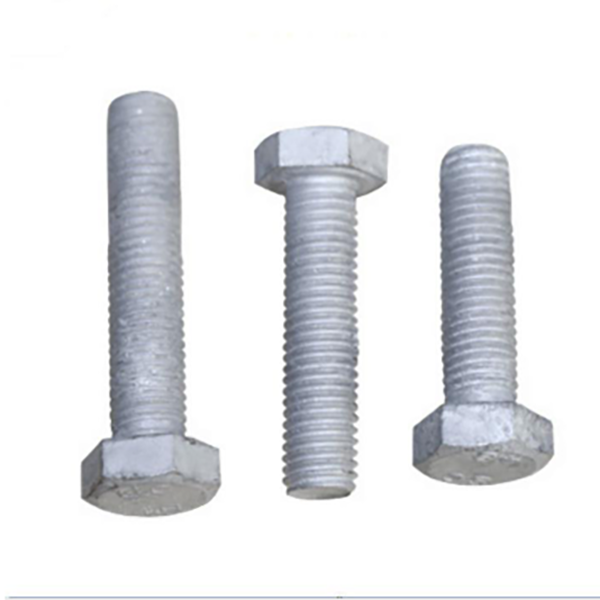
The Grade 8.8 Dacromet DIN 933 hex bolt combines medium-high mechanical strength with industry-leading corrosion protection. Widely adopted in outdoor structural steelwork, wind energy, railway infrastructure, and bridge construction, this fastener delivers reliable clamping performance under demanding environmental conditions — without the hydrogen embrittlement risk associated with electroplated alternatives.
Part 1 — Understanding Grade 8.8
According to ISO 898-1, the property class designation of a bolt consists of two numbers separated by a decimal point. For Grade 8.8:
First digit (8): Indicates 1/100 of the nominal tensile strength in MPa — i.e., minimum tensile strength = 800 MPa.
Second digit (8): Indicates the ratio of minimum yield strength to minimum tensile strength × 10 — i.e., yield ratio = 0.80, meaning minimum yield strength = 640 MPa.
Mechanical Properties
| Property | Value | Standard | Test Method |
| Tensile Strength (min.) | 800 MPa | ISO 898-1 | Tensile test |
| Yield Strength (min.) | 640 MPa | ISO 898-1 | Tensile test |
| Proof Load Stress | 580 MPa | ISO 898-1 | Proof load |
| Yield Ratio | 0.80 | ISO 898-1 | Calculation |
| Hardness (Vickers) | 245–335 HV | ISO 6507 | Vickers test |
| Hardness (Rockwell) | 22–32 HRC | ISO 6508 | Rockwell test |
| Elongation at Break (min.) | 12% | ISO 898-1 | Tensile test |
| Impact Toughness (min.) | 52 J @ -20 °C | ISO 898-1 | Charpy test |
Grade 8.8 fasteners are manufactured from medium-carbon steel (e.g., 45# / SAE 1045) or low-alloy steel (e.g., 40Cr / SCM435) and are subjected to quenching and tempering (Q&T) heat treatment to achieve the required strength profile. The combination of high tensile strength and a controlled yield ratio makes Grade 8.8 bolts highly reliable in pre-loaded structural connections.
Typical Application Fields
Steel construction: Structural bolting in frames, beams, trusses (BS EN 14399 / ASTM A325-equivalent).
Infrastructure: Bridge decking, crane rails, highway guardrails, expansion joints.
Renewable energy: Wind turbine tower base connections, solar mounting structures.
Machinery: General-purpose machinery frames, agricultural equipment, material handling.
Automotive (non-critical): Chassis mounting, body-to-frame, engine cradle supports.
Part 2 — DIN 933 Hex Bolt Standard
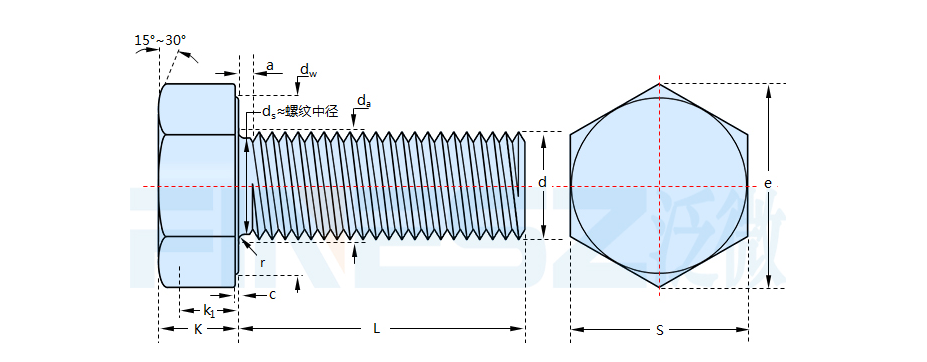
DIN 933 (Deutsches Institut für Normung, German Standards Institute) defines the dimensional and geometric requirements for fully threaded hexagon bolts with coarse metric pitch threads. Though largely superseded by ISO 4017 at the international level, DIN 933 remains the dominant specification in European and global industrial procurement.
Key Features of DIN 933
Full thread: The bolt is threaded along its entire shank length — maximising thread engagement and load distribution.
Hexagonal head: Standard width-across-flats dimension allows use with standard metric spanners and socket wrenches.
Coarse thread pitch: Metric coarse pitch (per ISO 261) for fast assembly and resistance to loosening under vibration.
Dimensional tolerance: Product grade A (m ≤ 10d or ≤ 150 mm) and product grade B (larger sizes) per ISO 4759-1.
DIN 933 Dimension Reference Table
Marking Identification
DIN 933 Grade 8.8 bolts are head-marked with the property class symbol "8.8" and the manufacturer's identification mark. When Dacromet-coated, an additional marking or tag may indicate the surface treatment.
Part 3 — Dacromet Corrosion Protection
Dacromet (also written as Dacrotised or DACROMET®) is a chromate-free, zinc-and-aluminium flake-based water-borne coating technology originally developed by Diamond Shamrock Chemicals. It provides outstanding sacrificial corrosion protection and has become the preferred surface treatment for Grade 8.8 bolts used in outdoor and aggressive-environment applications.
How Dacromet Works
The coating consists of multiple overlapping zinc and aluminium flakes bound together by an inorganic chromate-based binder matrix, applied by dip-spinning and cured at approximately 300 °C. The layered microstructure creates a tortuous path for corrosive agents, providing both barrier and sacrificial (galvanic) protection:
Barrier protection: Dense, overlapping flake layers physically block moisture and chloride ions from reaching the steel substrate.
Sacrificial (galvanic) protection: Zinc flakes are electrochemically less noble than steel; they corrode preferentially, protecting exposed steel edges at cut surfaces and damaged areas.
Self-healing effect: Zinc corrosion products partially seal minor coating defects, extending protection life.
Key Performance Data
| Property | Dacromet | Hot-Dip Galvanizing | Zinc Electroplating | Phosphating |
| Salt Spray Resistance | ≥ 480 h (can reach 1000+ h) | 200–500 h | 96–120 h | < 72 h |
| Coating Thickness | 6–10 µm | 50–100 µm | 5–15 µm | 5–15 µm |
| Hydrogen Embrittlement | None (baking not required) | None | High risk | Low risk |
| Thread Tolerance | Unaffected (thin coat) | Often affected | Generally OK | Generally OK |
| RoHS / REACH Compliant | Yes (hexavalent-Cr-free) | Yes | Varies | Yes |
| Typical Applications | Outdoor structure, wind tower, bridge | Heavy outdoor | Indoor/light | Indoor |
Salt spray test per ISO 9227. Typical Dacromet thickness: 6–10 µm. Results may vary with specific formulation and application method.
Applicable Standards & Specifications
ISO 10683: Non-electrolytically applied zinc flake coatings for fasteners.
DIN EN ISO 10683: European adoption of ISO 10683.
ASTM F1136: Zinc/aluminium corrosion-protective coatings for fasteners.
VDA 235-104: German automotive standard for zinc flake coatings.
About Fujirui Metal — Professional Fastener Manufacturer & Exporter
Fujirui Metal manufactures and exports precision fasteners including Grade 8.8 / 10.9 / 12.9 hex bolts, DIN 933 full-thread bolts, DIN 931 partial-thread bolts, stud bolts, and custom fasteners. Surface treatment options include Dacromet, Ruspert, hot-dip galvanising, and zinc electroplating. All products are manufactured to ISO, DIN, and ASTM standards with full material test certificates (MTC).