- Chinese
- French
- German
- Portuguese
- Spanish
- Russian
- Japanese
- Korean
- Arabic
- Irish
- Greek
- Turkish
- Italian
- Danish
- Romanian
- Indonesian
- Czech
- Afrikaans
- Swedish
- Polish
- Basque
- Catalan
- Esperanto
- Hindi
- Lao
- Albanian
- Amharic
- Armenian
- Azerbaijani
- Belarusian
- Bengali
- Bosnian
- Bulgarian
- Cebuano
- Chichewa
- Corsican
- Croatian
- Dutch
- Estonian
- Filipino
- Finnish
- Frisian
- Galician
- Georgian
- Gujarati
- Haitian
- Hausa
- Hawaiian
- Hebrew
- Hmong
- Hungarian
- Icelandic
- Igbo
- Javanese
- Kannada
- Kazakh
- Khmer
- Kurdish
- Kyrgyz
- Latin
- Latvian
- Lithuanian
- Luxembou..
- Macedonian
- Malagasy
- Malay
- Malayalam
- Maltese
- Maori
- Marathi
- Mongolian
- Burmese
- Nepali
- Norwegian
- Pashto
- Persian
- Punjabi
- Serbian
- Sesotho
- Sinhala
- Slovak
- Slovenian
- Somali
- Samoan
- Scots Gaelic
- Shona
- Sindhi
- Sundanese
- Swahili
- Tajik
- Tamil
- Telugu
- Thai
- Ukrainian
- Urdu
- Uzbek
- Vietnamese
- Welsh
- Xhosa
- Yiddish
- Yoruba
- Zulu
- Kinyarwanda
- Tatar
- Oriya
- Turkmen
- Uyghur

Self-Drilling Screws
2026-11-06
1. Why the Self-Drilling Screw Changed Metal Construction
For roofers, cladding contractors, HVAC installers, and solar-panel mounting crews, this screw is now the default choice for fixing thin-gauge steel. And because a self-drilling screw normally pierces bare or galvanized steel outdoors, its anti-corrosion performance is just as important as its drilling performance — a screw that drills beautifully but rusts in two seasons will leak, stain, and eventually fail.
2. How a Self-Drilling Screw Works
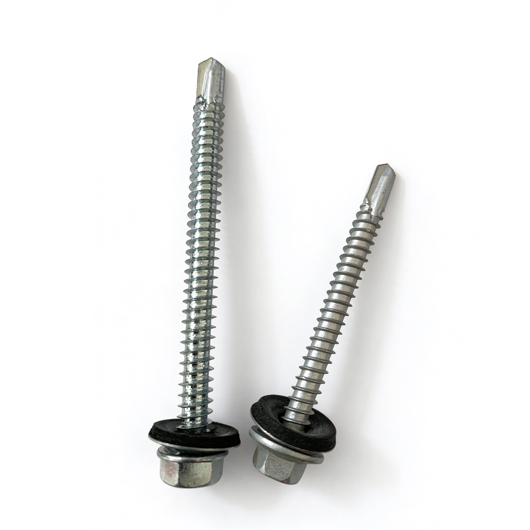
A self-drilling screw is a hardened steel screw whose tip is ground into a miniature twist drill. The working sequence at the point is:
1.Position— the screw is seated on the top sheet under light pressure and speed.
2.Drill— the fluted tip cuts a clean hole through the steel; the flutes lift out the swarf so chips never jam the threads.
3.Thread-form— as the drill point exits the base steel, the cutting action stops and the threads engage, tapping into the substrate.
4.Clamp— the head draws the panels together; the sealing washer (if fitted) compresses to form a weather-tight, rust-resistant seal.
The critical design rule is thickness matching: each drill point size has a drilling capacity — a No. 2 point typically handles about 0.6–2.5 mm of total steel, while a No. 5 point can drill up to about 12.5 mm. Driving a screw beyond its capacity burns the tip, work-hardens the steel, and produces a loose, corrosion-prone joint.
| Drill point | Total drilling capacity (steel) | Typical application | Screw diameter range |
| No. 1 | up to ~0.6 mm | Light sheet to sheet | 3.5–4.2 mm (#8–#10) |
| No. 2 | 0.6–2.5 mm | Roofing, cladding, purlins | 4.2–5.5 mm (#8–#12) |
| No. 3 | 1.7–4.5 mm | Structural steel framing | 4.8–6.3 mm (#12–#14) |
| No. 4 | 3.0–6.5 mm | Heavy gauge framing | 5.5–6.3 mm (#12–#14) |
| No. 5 | 6.0–12.5 mm | Thick steel plate | 6.3 mm (#14) |
3. The Corrosion Problem — and How Screw Coatings Fight Rust
A self-drilling screw is the single most corrosion-exposed fastener on a building envelope. It sits at the junction of two or more galvanized sheets, endures years of UV, rain, and thermal cycling, and its head often stands proud of the coating system. Once surface rust appears at the head, the stain runs down the panel, the sealing washer loses compression, and the joint begins to weep.
lZinc electroplating (white / yellow / blue passivated). The economic baseline. Clear or yellow trivalent passivation slows white rust, and 5–8 µm of zinc gives roughly 200–400 hours to white rust in a neutral salt spray test (ISO 9227 / ASTM B117). Suitable for interiors and sheltered exteriors.
lMechanical galvanizing. Zinc powder is cold-welded onto the screw surface, building a thicker, uniformly distributed coating (up to 40–55 µm) without hydrogen embrittlement — an important anti-corrosion advantage over electroplating for hardened screws.
4. Conclusion
The self-drilling screw compresses drilling, threading and fastening into a single motion, and in doing so it has become the structural and watertight bond that holds modern steel envelopes together. But its real engineering value lies in the pairing of two properties: a hardened, correctly sized drill point that makes a clean hole, and a high-performance anti-corrosion coating system that keeps the screw rust-free for the life of the building. Choose the screw by drilling capacity, and choose the coating by salt-spray data — and the humble screw will outlast the panel it holds down.