- English
- Chinese
- French
- German
- Portuguese
- Spanish
- Russian
- Japanese
- Korean
- Arabic
- Irish
- Greek
- Turkish
- Italian
- Danish
- Romanian
- Indonesian
- Czech
- Afrikaans
- Swedish
- Polish
- Basque
- Catalan
- Esperanto
- Hindi
- Lao
- Albanian
- Amharic
- Armenian
- Azerbaijani
- Belarusian
- Bengali
- Bosnian
- Bulgarian
- Cebuano
- Chichewa
- Corsican
- Croatian
- Dutch
- Estonian
- Filipino
- Finnish
- Frisian
- Galician
- Georgian
- Gujarati
- Haitian
- Hausa
- Hawaiian
- Hebrew
- Hmong
- Hungarian
- Icelandic
- Igbo
- Javanese
- Kannada
- Kazakh
- Khmer
- Kurdish
- Kyrgyz
- Latin
- Latvian
- Lithuanian
- Luxembou..
- Macedonian
- Malagasy
- Malay
- Malayalam
- Maltese
- Maori
- Marathi
- Mongolian
- Burmese
- Nepali
- Norwegian
- Pashto
- Persian
- Punjabi
- Serbian
- Sesotho
- Sinhala
- Slovak
- Slovenian
- Somali
- Scots Gaelic
- Shona
- Sindhi
- Sundanese
- Swahili
- Tajik
- Tamil
- Telugu
- Thai
- Ukrainian
- Urdu
- Uzbek
- Vietnamese
- Welsh
- Xhosa
- Yiddish
- Yoruba
- Zulu
- Kinyarwanda
- Tatar
- Oriya
- Turkmen
- Uyghur

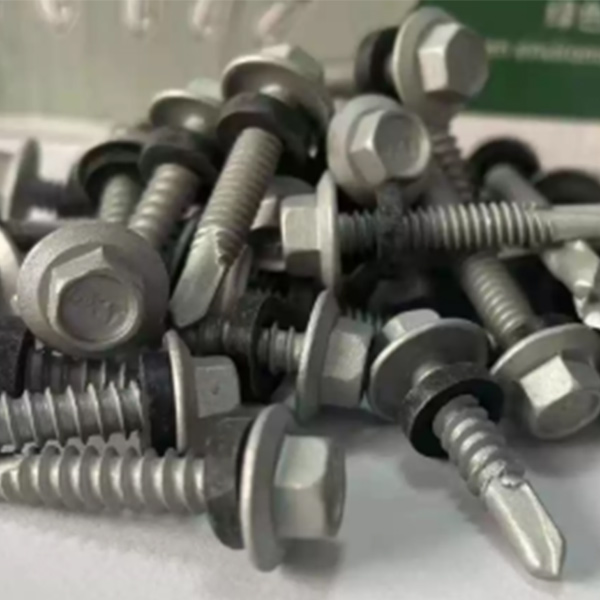
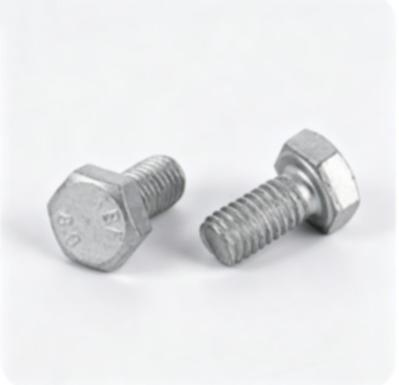
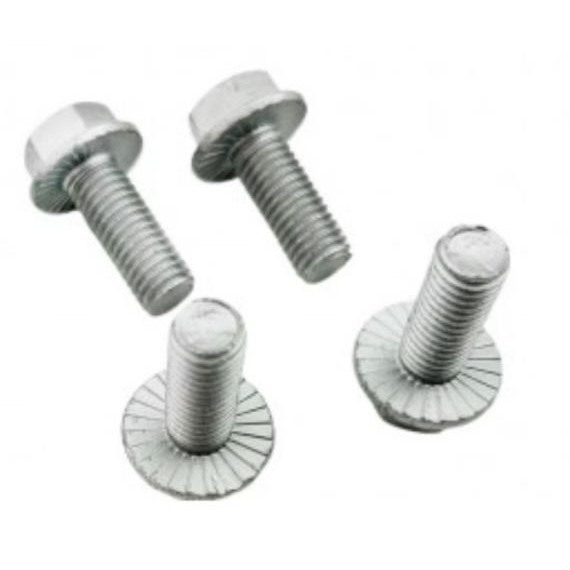
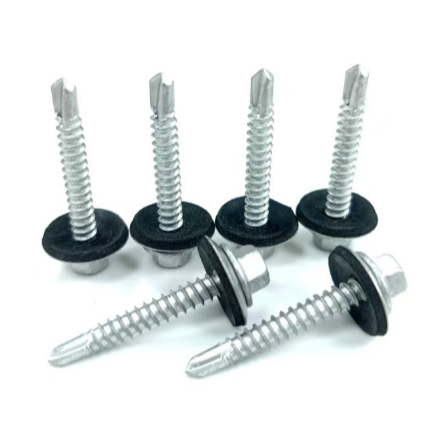
Ruspert Self-Tapping Screws
2026-08-04
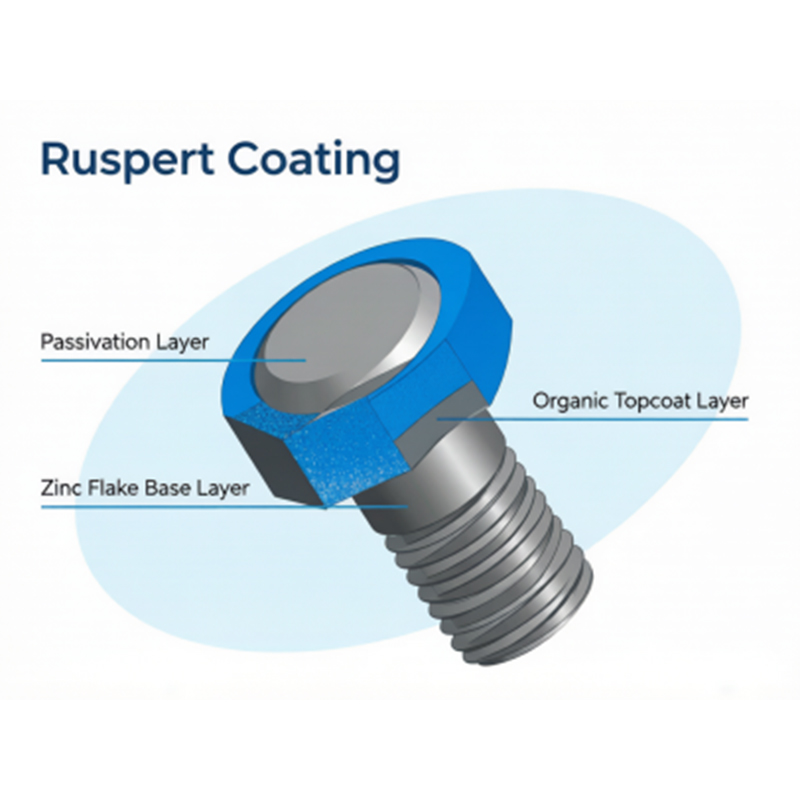
| Property | Description |
| Corrosion Resistance | Exceeds 1,000 hours of neutral salt spray testing per ASTM B117, far surpassing conventional zinc plating. |
| Hydrogen Embrittlement Free | The coating process does not involve electrolytic reactions, eliminating the risk of hydrogen embrittlement. |
| Uniform Coating | Achieves consistent coverage on complex geometries, including threads and recessed areas. |
| Environmental Compliance | Free of Cr(VI) and compliant with RoHS, REACH, and ELV directives. |
| Aesthetic Finish | Distinctive silver-blue metallic appearance, ideal for visible fastener applications. |
| Electrical Conductivity | Maintains good electrical conductivity, making it suitable for grounding and electrical assemblies. |
Table 2. Salt Spray Test Comparison of Common Fastener Coatings
| Coating Type | Salt Spray Hours (ASTM B117) | Cr(VI) Content |
| Zinc Plating (Clear) | 96 - 200 hrs | None |
| Zinc Plating (Yellow) | 200 - 400 hrs | May contain |
| Dacromet | 500 - 1,000 hrs | None |
| Ruspert | 1,000+ hrs | None |
3. Self-Tapping Screws: An Overview
3.1 Definition and Working Principle
Self-tapping screws are threaded fasteners designed to create their own internal threads as they are driven into an unthreaded pilot hole. Unlike machine screws, which require a pre-tapped hole, self-tapping screws eliminate the need for a separate tapping operation, significantly reducing assembly time and cost. The screw achieves this through a specially engineered thread geometry and a pointed or tapered lead that cuts or forms the thread as the screw is rotated and advanced.
3.2 Types of Self-Tapping Screws
Self-tapping screws are broadly categorized into two families: thread-forming (which displace material to create threads) and thread-cutting (which physically remove material via cutting flutes). Within these families, several standard types are widely used:
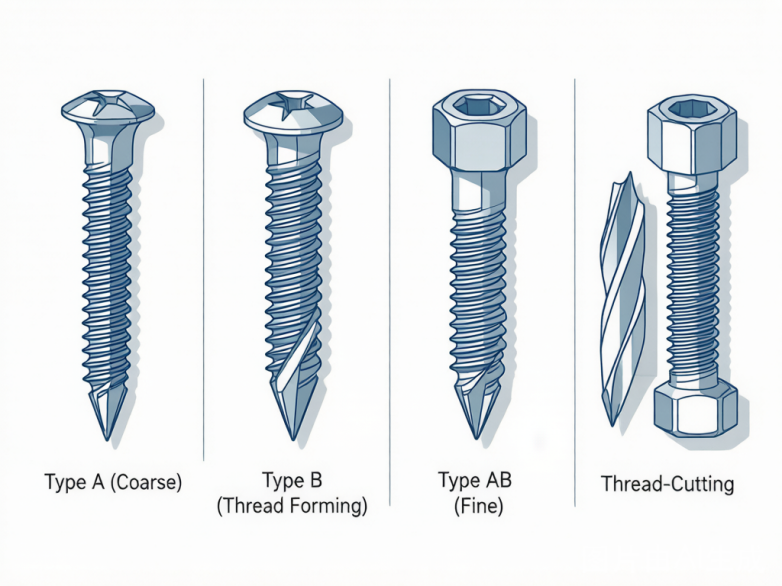
Figure 2. Common self-tapping screw thread profiles and cutting flute designs.
4. Ruspert Self-Tapping Screws: The Synergy
When Ruspert surface treatment is applied to self-tapping screws, the result is a fastener that combines the assembly efficiency of thread-forming technology with one of the highest levels of corrosion protection available in the industry. The non-electrolytic dip-spin coating process ensures uniform coverage even on the complex thread geometry, and the absence of hydrogen embrittlement risk makes Ruspert self-tapping screws safe for use in high-strength steel grades (up to Grade 10.9 and beyond).
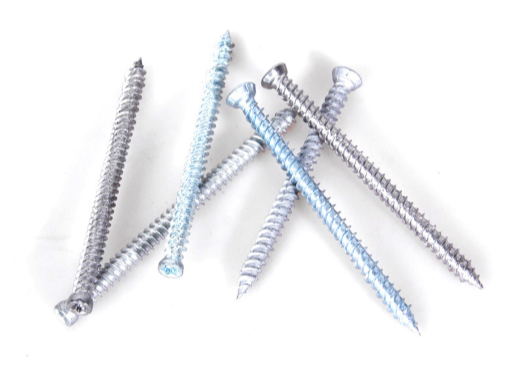
Figure 3. Ruspert-coated self-tapping screws in various head and drive configurations.
5. Conclusion
Ruspert self-tapping screws represent a convergence of two well-proven technologies: a multi-layer, environmentally compliant coating system that delivers over 1,000 hours of salt spray protection, and a self-tapping thread design that eliminates the need for pre-tapped holes. Together, they offer a fastening solution that reduces installation time, lowers total cost of ownership, and ensures structural integrity in the most demanding environments. For engineers and procurement professionals seeking a reliable, corrosion-resistant fastener that performs across decades of service life, Ruspert self-tapping screws remain an excellent and proven choice.