- English
- Chinese
- French
- German
- Portuguese
- Spanish
- Russian
- Japanese
- Korean
- Arabic
- Irish
- Greek
- Turkish
- Italian
- Danish
- Romanian
- Indonesian
- Czech
- Afrikaans
- Swedish
- Polish
- Catalan
- Esperanto
- Hindi
- Lao
- Albanian
- Amharic
- Armenian
- Azerbaijani
- Belarusian
- Bengali
- Bosnian
- Bulgarian
- Cebuano
- Chichewa
- Corsican
- Croatian
- Dutch
- Estonian
- Filipino
- Finnish
- Frisian
- Galician
- Georgian
- Gujarati
- Haitian
- Hausa
- Hawaiian
- Hebrew
- Hmong
- Hungarian
- Icelandic
- Igbo
- Javanese
- Kannada
- Kazakh
- Khmer
- Kurdish
- Kyrgyz
- Latin
- Latvian
- Lithuanian
- Luxembou..
- Macedonian
- Malagasy
- Malay
- Malayalam
- Maltese
- Maori
- Marathi
- Mongolian
- Burmese
- Nepali
- Norwegian
- Pashto
- Persian
- Punjabi
- Serbian
- Sesotho
- Sinhala
- Slovak
- Slovenian
- Somali
- Samoan
- Scots Gaelic
- Shona
- Sindhi
- Sundanese
- Swahili
- Tajik
- Tamil
- Telugu
- Thai
- Ukrainian
- Urdu
- Uzbek
- Vietnamese
- Welsh
- Xhosa
- Yiddish
- Yoruba
- Zulu
- Kinyarwanda
- Tatar
- Oriya
- Turkmen
- Uyghur

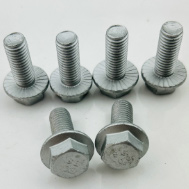
Dacromet Flange Bolts: A Comprehensive Introduction to High-Performance Anti-Corrosion Fasteners
2026-09-21
1. Introduction to Flange Bolts and Anti-Corrosion Requirements
Flange bolts are critical fasteners used extensively in piping systems, pressure vessels, structural steel connections, automotive assemblies, wind power installations, petrochemical plants, and heavy industrial equipment. These specialized bolts ensure secure, leak-proof joints between flanges under high pressure and mechanical load. However, in real-world service environments involving moisture, salt spray, industrial chemicals, high humidity, or coastal atmospheres, ordinary steel bolts are highly susceptible to corrosion and rust. Progressive oxidation reduces clamping force, causes joint leakage, weakens structural integrity, and leads to costly premature failure.
To address these challenges, modern industry relies on advanced surface protection technologies. Among the most effective solutions is Dacromet (also known as Dacomet or zinc-aluminum flake coating). Dacromet-coated flange bolts deliver outstanding corrosion resistance, exceptional anti-rust performance, and long-term rust prevention. This article introduces Dacromet flange bolts in detail, covering composition, performance advantages, technical characteristics, and application value in demanding anti-corrosion environments.
2. What Is Dacromet Coating?
Dacromet is a high-performance zinc-aluminum flake coating system developed as an advanced alternative to traditional electroplating and hot-dip galvanizing. The coating consists of overlapping layers of zinc and aluminum flakes suspended in an inorganic binder. After application by dip-spin, spray, or dip-drain methods and high-temperature curing, the flakes form a dense, multi-layered barrier that provides multiple mechanisms of anti-corrosion protection.
Unlike conventional zinc plating that relies on a single continuous metallic layer, the lamellar structure of zinc and aluminum flakes creates a complex pathway that significantly slows penetration of water, oxygen, and chloride ions. This unique microstructure forms the foundation of the coating’s superior corrosion resistance and long-lasting rust prevention capability. Typical Dacromet coating thickness ranges from 5 to 12 micrometers (μm). Despite its thin profile, a properly applied Dacromet layer can achieve salt spray resistance exceeding 1,000 hours—and often over 2,000 hours—without red rust appearance. This level of anti-rust performance far surpasses conventional electro-galvanized coatings and frequently outperforms hot-dip galvanizing in cyclic and long-term exposure tests.
3. Key Advantages of Dacromet Flange Bolts
Dacromet flange bolts combine mechanical reliability with superior anti-corrosion durability, making them ideal for high-strength and critical fastening applications.
3.1 Outstanding Corrosion Resistance and Anti-Rust Performance
The primary reason for selecting Dacromet-coated flange bolts is their exceptional corrosion resistance. Independent salt spray tests (ASTM B117 / ISO 9227) consistently show that Dacromet coatings withstand 1,000 to 2,000 hours or more before red rust appears. Comparative evaluations demonstrate that Dacromet often provides 3 to 10 times better anti-rust performance than standard zinc electroplating. This superior rust prevention capability translates into significantly extended service life for flange connections exposed to aggressive environments such as coastal, marine, and industrial atmospheres.
3.2 No Risk of Hydrogen Embrittlement
High-strength flange bolts (grades 8.8, 10.9, 12.9 and ASTM A490 / F3125 structural bolts) are particularly sensitive to hydrogen embrittlement. Traditional electroplating involves acidic pickling and electrolytic deposition that can introduce hydrogen into the steel, risking delayed brittle fracture. Dacromet is a non-electrolytic process that avoids this risk, making Dacromet-treated bolts the preferred anti-corrosion solution for high-tensile flange bolts.
3.3 Thin Coating with Excellent Thread Compatibility
With a typical thickness of only 5–12 μm, the Dacromet film does not significantly alter thread dimensions or interfere with nut engagement. In contrast, hot-dip galvanizing often produces thick, uneven coatings that fill threads and require oversized nuts. Dacromet flange bolts can therefore be assembled with standard nuts while still delivering outstanding corrosion resistance and anti-rust protection.
3.4 High-Temperature Stability and Multi-Mechanism Protection
Dacromet coatings maintain their anti-corrosion integrity at elevated temperatures (typically up to 250–300 °C), which is valuable for flange bolts near engines, exhaust systems, or outdoor structures. The coating provides four complementary rust prevention mechanisms: (1) Barrier protection from overlapping zinc-aluminum flakes; (2) Galvanic sacrificial protection by zinc; (3) Self-repairing effect through oxide filling of minor damages; and (4) Passivation by the inorganic binder that retards further corrosion progression.
4. Typical Applications of Dacromet Flange Bolts
Owing to their outstanding anti-corrosion and anti-rust properties, Dacromet flange bolts are widely specified across industries requiring long-term reliability under corrosive conditions:
- Offshore and coastal structures: Wind turbine towers, offshore platforms, coastal bridges, and port facilities benefit from superior salt-spray corrosion resistance.
- Automotive and transportation: Chassis, suspension, exhaust, and underbody fasteners require reliable rust preventionagainst road salt and humidity.
- Petrochemical and chemical processing: Pipeline and reactor flange connections face continuous chemical exposure; Dacromet provides durable anti-corrosion
- Power generation and transmission: Transmission tower bolts and power plant equipment rely on Dacromet’s anti-rustperformance in outdoor environments.
- Heavy machinery, agriculture, and construction: Equipment operating in wet soil, fertilizers, or marine atmospheres depends on Dacromet’s corrosion resistanceand long-term rust prevention.
5. Summary of Benefits and Conclusion
Choosing Dacromet-coated flange bolts brings multiple practical advantages:
- Dramatically improved corrosion resistanceand anti-rust performance compared with conventional zinc coatings.
- Longer maintenance intervals and reduced lifecycle cost due to extended rust prevention.
- Safe application on high-strength bolts without hydrogen embrittlement risk.
- Preservation of precise thread geometry for reliable assembly and reusability.
- Excellent performance in salt-laden, humid, chemical, and high-temperature environments.
In conclusion, Dacromet flange bolts represent a mature, high-performance solution for engineers and maintenance professionals who demand both mechanical reliability and superior anti-corrosion protection. Through the unique combination of barrier protection, sacrificial zinc action, self-healing behavior, and inorganic passivation, Dacromet coatings deliver exceptional corrosion resistance, outstanding anti-rust capability, and long-term rust prevention. Whether used in offshore wind turbines, coastal infrastructure, automotive chassis, petrochemical plants, or heavy industrial equipment, Dacromet-coated flange bolts consistently outperform traditional surface treatments in durability and reliability.
For critical flange connections exposed to corrosive service conditions, specifying Dacromet flange bolts is a technically sound decision that enhances safety, reduces lifecycle costs, and ensures lasting structural integrity through superior corrosion resistance and reliable rust prevention.