- English
- Chinese
- French
- German
- Portuguese
- Spanish
- Russian
- Japanese
- Korean
- Arabic
- Irish
- Greek
- Turkish
- Italian
- Danish
- Romanian
- Indonesian
- Czech
- Afrikaans
- Swedish
- Polish
- Basque
- Catalan
- Esperanto
- Hindi
- Lao
- Albanian
- Amharic
- Armenian
- Azerbaijani
- Belarusian
- Bengali
- Bosnian
- Bulgarian
- Cebuano
- Chichewa
- Corsican
- Croatian
- Dutch
- Estonian
- Filipino
- Finnish
- Frisian
- Galician
- Georgian
- Gujarati
- Haitian
- Hausa
- Hawaiian
- Hebrew
- Hmong
- Hungarian
- Icelandic
- Igbo
- Javanese
- Kannada
- Kazakh
- Khmer
- Kurdish
- Kyrgyz
- Latin
- Latvian
- Lithuanian
- Luxembou..
- Macedonian
- Malagasy
- Malay
- Malayalam
- Maltese
- Maori
- Marathi
- Mongolian
- Burmese
- Nepali
- Norwegian
- Pashto
- Persian
- Punjabi
- Serbian
- Sesotho
- Sinhala
- Slovak
- Slovenian
- Somali
- Scots Gaelic
- Shona
- Sindhi
- Sundanese
- Swahili
- Tajik
- Tamil
- Telugu
- Thai
- Ukrainian
- Urdu
- Uzbek
- Vietnamese
- Welsh
- Xhosa
- Yiddish
- Yoruba
- Zulu
- Kinyarwanda
- Tatar
- Oriya
- Turkmen
- Uyghur

Dacromet Flat Washers: A Comprehensive Overview
2026-08-22
содержание
1. Introduction
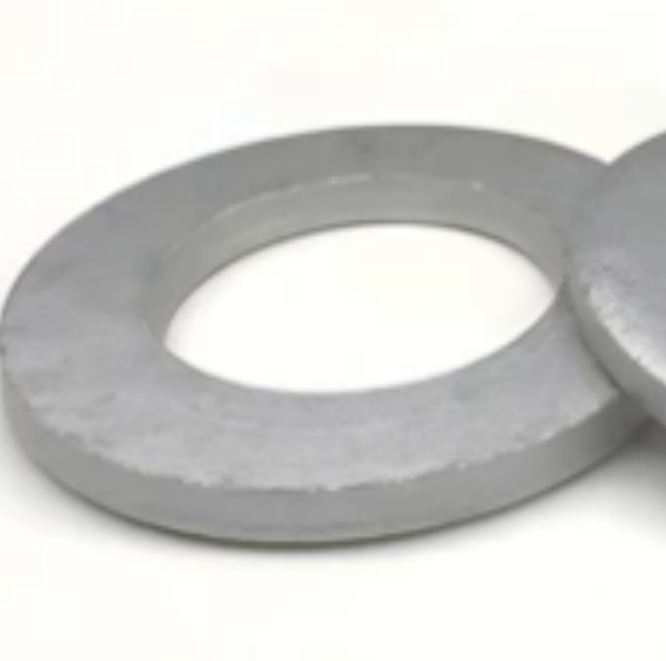
Flat washers are essential components in mechanical fastening systems. These thin, flat discs with a central hole distribute the load of a bolt or screw, protect the joined surfaces from damage, and improve the reliability of the connection. In corrosive environments—such as those exposed to moisture, road salts, chemicals, or elevated temperatures—standard untreated or zinc-plated steel washers often corrode prematurely, leading to reduced clamping force, joint failure, or costly maintenance.
To address this challenge, advanced surface treatments have been developed. Among the most effective is Dacromet coating, a zinc-aluminum flake system widely applied to flat washers for automotive, construction, marine, and industrial use. This article introduces Dacromet flat washers, explaining the coating technology, key properties, standards, advantages, applications, and comparisons with alternative finishes.
2. What is Dacromet Coating?
Dacromet (DACROMET®) is a non-electrolytic, water-based inorganic coating composed of zinc and aluminum flakes dispersed in a chromate binder. Originally developed in the 1970s to combat road-salt corrosion on vehicles, it is applied by dip-spin, spray, or dip-drain methods after alkaline degreasing and mechanical cleaning (no acid pickling is used). The coating is then cured at approximately 300°C, producing a thin (typically 5–15 μm), uniform metallic silver-gray film that adheres firmly to the steel substrate.
Its protective mechanism operates in three complementary ways:
- Barrier protection — overlapping zinc and aluminum flakes form a dense physical barrier against moisture, oxygen, and corrosive agents.
- Cathodic (sacrificial) protection — zinc corrodes preferentially, shielding the underlying steel even if the coating is slightly damaged.
- Passivation — chromium compounds create stable oxide films that slow further corrosion and help seal minor surface defects.
3. Key Properties of Dacromet Flat Washers
3.1 Superior Corrosion Resistance
In neutral salt-spray testing (ASTM B117 / ISO 9227), Dacromet coatings commonly achieve 500–1,000+ hours without red rust—typically 5–10 times longer than conventional zinc electroplating of similar thickness. Higher coating weights (Grade B or high-thickness variants) can exceed 1,000 hours, supporting service lives of 5–15 years or more in harsh outdoor or underbody environments.
3.2 High Temperature Resistance
The coating retains its integrity and protective properties up to approximately 300°C (572°F). This makes Dacromet flat washers suitable for components located near engines, exhaust systems, braking assemblies, and other heat sources where ordinary zinc plating would soften, peel, or lose corrosion resistance.
3.3 No Hydrogen Embrittlement
Because the process is non-electrolytic and avoids acid pickling, Dacromet introduces no risk of hydrogen embrittlement. This is a decisive advantage for high-strength washers (hardness grades 200 HV, 300 HV and above) and for use together with high-tensile bolts (Grade 10.9 and higher), where hydrogen-induced cracking is a serious concern with traditional electroplated finishes.
3.4 Thin, Uniform Film and Additional Benefits
With a typical dry-film thickness of only 5–12 μm, the coating does not significantly alter critical dimensions or thread clearances, preserving precise fit and clamping performance. Further benefits include strong adhesion to the substrate, good paintability, controlled coefficient of friction (especially when a lubricated topcoat is applied), and bimetallic compatibility with aluminum components.
4. Standards, Materials, and Specifications
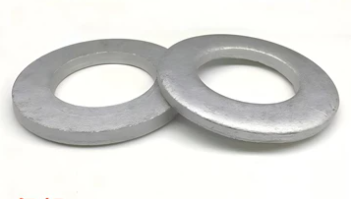
Dacromet flat washers are manufactured to widely recognized international dimensional standards, including DIN 125, ISO 7089, DIN 9021, and ANSI/ASME B18.22.1. Base materials are primarily carbon steel supplied in hardness grades such as 100 HV, 140 HV, 200 HV, or 300 HV; stainless-steel versions are also available for specialized requirements. Sizes commonly range from small metric diameters (M1.6 / Φ1.7 mm) to large sizes (M160 / Φ165 mm and beyond), covering both standard and large-outer-diameter (fender) washers. Coating grades are typically Grade A (approximately 24 g/m²) or Grade B (approximately 36 g/m²), frequently offered with optional topcoats that further improve lubricity or corrosion performance. Reputable suppliers provide salt-spray test reports, thickness measurements, and material certificates.
5. Advantages over Conventional Coatings
- Extended service life — dramatically longer corrosion protection significantly reduces maintenance intervals and replacement costs.
- Safe for high-strength fasteners — complete absence of hydrogen embrittlement risk.
- Dimensional precision — the thin film preserves tolerances and proper thread engagement.
- Thermal stability — reliable performance in elevated-temperature locations.
- Favorable lifecycle cost — although the initial unit price is higher than basic zinc plating, the longer service life and reduced downtime usually yield a lower total cost of ownership.
6. Typical Applications
Automotive: Chassis, suspension, underbody, exhaust, and engine-compartment fasteners exposed to road salt and moisture. Many OEMs and Tier-1 suppliers specifically require zinc-flake coatings such as Dacromet for critical washers and fasteners.
Construction & Infrastructure: Structural steel connections, bridges, tunnels, offshore platforms, scaffolding, fencing, and outdoor architectural hardware that must withstand long-term outdoor exposure.
Other sectors: Marine and coastal equipment, agricultural and construction machinery, railway and transportation systems, wind-energy towers and nacelles, white goods and appliances, and general industrial assemblies operating in corrosive or high-humidity environments.
7. Comparison with Alternative Coatings
Zinc electroplating is inexpensive and widely available, yet it offers limited salt-spray resistance (typically 72–200 hours) and carries a hydrogen-embrittlement risk on high-strength parts.
Hot-dip galvanizing provides excellent corrosion protection and sacrificial behavior, but the relatively thick coating can interfere with thread fit and dimensional accuracy, making it less suitable for precision or small washers.
Other zinc-flake systems (for example Geomet®) deliver performance in the same general class as Dacromet. The final choice often depends on specific OEM specifications, available topcoat options, and regional supply chains. Overall, Dacromet offers an effective balance of thin film thickness, high corrosion resistance, thermal stability, and freedom from hydrogen embrittlement.
8. Conclusion
Dacromet flat washers combine the mechanical benefits of conventional flat washers—load distribution and surface protection—with an advanced zinc-aluminum flake coating that delivers outstanding corrosion resistance, high-temperature performance, and safety for high-strength applications. Their thin, uniform film, proven automotive pedigree, and long service life make them a preferred choice across the automotive, construction, marine, and broader industrial sectors.
When specifying these washers, attention should be given to the required hardness grade, dimensional standard (DIN, ISO, or ANSI), coating weight or grade, and any need for lubricated topcoats. Partnering with manufacturers who can supply salt-spray test data and material certifications helps ensure reliable performance in service. In applications where corrosion, heat, or high strength are critical factors, Dacromet-coated flat washers remain a proven and cost-effective solution.
— End of Article —