- English
- Chinese
- French
- German
- Portuguese
- Spanish
- Russian
- Japanese
- Korean
- Arabic
- Irish
- Greek
- Turkish
- Italian
- Danish
- Romanian
- Indonesian
- Czech
- Afrikaans
- Swedish
- Polish
- Catalan
- Esperanto
- Hindi
- Lao
- Albanian
- Amharic
- Armenian
- Azerbaijani
- Belarusian
- Bengali
- Bosnian
- Bulgarian
- Cebuano
- Chichewa
- Corsican
- Croatian
- Dutch
- Estonian
- Filipino
- Finnish
- Frisian
- Galician
- Georgian
- Gujarati
- Haitian
- Hausa
- Hawaiian
- Hebrew
- Hmong
- Hungarian
- Icelandic
- Igbo
- Javanese
- Kannada
- Kazakh
- Khmer
- Kurdish
- Kyrgyz
- Latin
- Latvian
- Lithuanian
- Luxembou..
- Macedonian
- Malagasy
- Malay
- Malayalam
- Maltese
- Maori
- Marathi
- Mongolian
- Burmese
- Nepali
- Norwegian
- Pashto
- Persian
- Punjabi
- Serbian
- Sesotho
- Sinhala
- Slovak
- Slovenian
- Somali
- Samoan
- Scots Gaelic
- Shona
- Sindhi
- Sundanese
- Swahili
- Tajik
- Tamil
- Telugu
- Thai
- Ukrainian
- Urdu
- Uzbek
- Vietnamese
- Welsh
- Xhosa
- Yiddish
- Yoruba
- Zulu
- Kinyarwanda
- Tatar
- Oriya
- Turkmen
- Uyghur

Grade 8.8 Hex Bolts
2026-08-03
1. Grade 8.8 — Medium-High Strength Fastener Class
1.1 Decoding the 8.8 Designation
The marking “8.8” is a property class designation defined by ISO 898-1, the international standard governing mechanical properties of carbon steel and alloy steel fasteners. The two-digit system encodes two key mechanical parameters:
● First digit (8): Indicates one-tenth of the nominal tensile strength in megapascals → 8 × 100 = 800 MPa minimum tensile strength.
● Second digit (.8): Represents the yield ratio → 0.8 × 800 = 640 MPa minimum yield strength.
Grade 8.8 fasteners are the most widely used general-purpose structural fasteners worldwide, covering hex bolts, hex cap screws, carriage bolts, stud bolts, and fully threaded screws for steel construction, automotive assemblies, and general machinery.
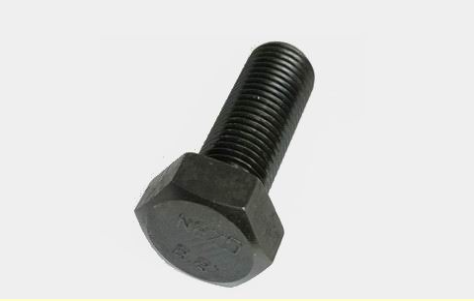
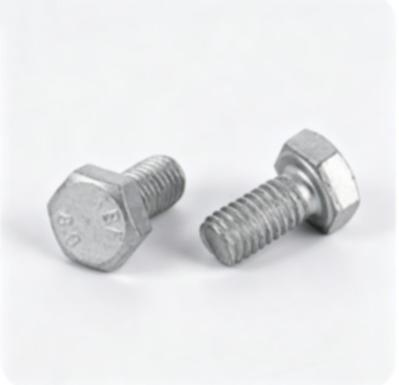
Figure 1. Grade 8.8 hex bolts with property class marking
1.2 Mechanical Properties
Grade 8.8 fasteners are manufactured from medium carbon steel and undergo quenching and tempering (Q&T) to achieve the required mechanical performance. Key properties per ISO 898-1:
| Property | Value | Unit |
| Minimum Tensile Strength (Rm) | 800 | MPa |
| Minimum Yield Strength (ReL) | 640 | MPa |
| Minimum Elongation after Fracture | ≥ 12 | % |
| Core Hardness (HV) | 250–310 | HV |
| Typical Q&T Hardness (HRC) | 22–32 | HRC |
| Nominal Bolt Diameter Range | M5 – M39 | mm |
Table 1. Key mechanical properties of Grade 8.8 fasteners per ISO 898-1
1.3 Recommended Materials
Selecting the correct raw material is the foundation of producing reliable Grade 8.8 fasteners. The following steels, combined with proper Q&T, achieve consistent Grade 8.8 performance:
● 35# Medium-Carbon Steel — Suitable for smaller-diameter fasteners (≤ M16). Cost-effective, adequate hardenability after Q&T.
● 45# Medium-Carbon Steel — The most popular choice for Grade 8.8 hex bolts and stud bolts. Good machinability, stable mechanical properties after Q&T.
● 40Cr Alloy Steel — Preferred for larger-diameter bolts (M20+). Chromium addition improves hardenability and tensile uniformity across cross-sections.
1.4 Grade Comparison
| Grade | Tensile (MPa) | Yield (MPa) | Recommended Materials |
| 4.6 | 400 | 240 | Low carbon steel, non-heat-treated |
| 4.8 | 420 | 340 | Low carbon steel, cold-worked |
| 8.8 | 800 | 640 | 35# / 45# Carbon Steel, 40Cr Alloy Steel; Q&T |
| 10.9 | 1,040 | 940 | 40Cr, 35CrMo, 42CrMo, SCM435; Q&T |
| 12.9 | 1,220 | 1,100 | 42CrMo4 / SCM440, 35CrMoV; Q&T 39–44 HRC |
Table 2. Common fastener property classes and recommended materials
2. Hex Bolts — The Most Versatile Fastener
2.1 What Is a Hex Bolt?
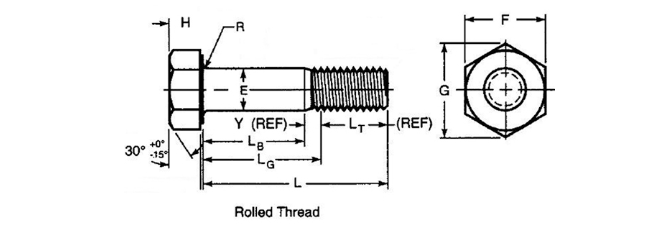
A hex bolt (hexagonal head bolt) is a threaded fastener with a six-sided head, designed to be inserted through holes in assembled parts and secured by a mating nut. The hexagonal geometry allows wrench or socket engagement from multiple angles, making it the most practical and widely used bolt type across all industries. Two main variants exist:
● Hex Bolt (ISO 4014 / DIN 931) — Partially threaded: an unthreaded shank portion provides shear strength and alignment, ideal for structural connections.
● Hex Cap Screw (ISO 4017 / DIN 933) — Fully threaded: threads run the entire length, suited for applications requiring maximum thread engagement.
2.2 Common Hex Bolt Types & Variants
● Hex Head Bolt / Cap Screw — Standard six-sided head; most versatile, used in construction, machinery, automotive.
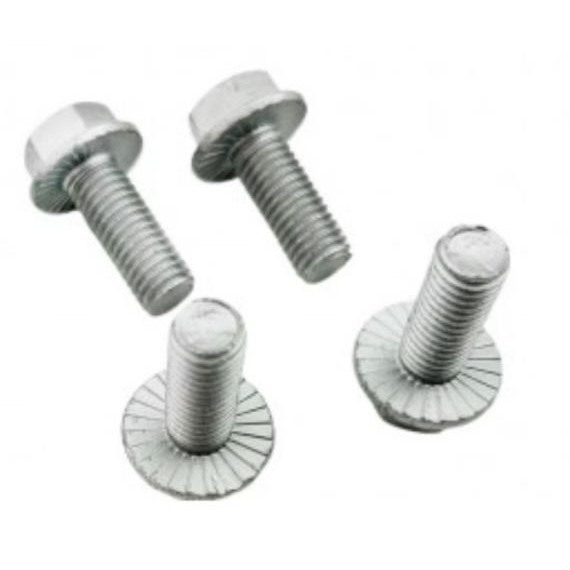
● Hex Flange Bolt — Integrated washer-like flange under the head; distributes clamp load, eliminates separate washer.
● Heavy Hex Bolt (ASTM A325) — Larger head for structural steel connections; specified in North American standards.
● Hex Lag Bolt / Carriage Bolt — Specialized variants for wood-to-steel and timber connections.
2.3 Common Sizes & Dimensions
| Size | Pitch | Wrench | Head dia. | Head ht. | Shank dia. | Length Range |
| M6 | 1.0 | 10 mm | 10.0 | 4.0 | 6.0 | 16–60 |
| M8 | 1.25 | 13 mm | 13.0 | 5.3 | 8.0 | 20–80 |
| M10 | 1.5 | 16 mm | 16.0 | 6.4 | 10.0 | 25–100 |
| M12 | 1.75 | 18 mm | 18.0 | 7.5 | 12.0 | 30–120 |
| M16 | 2.0 | 24 mm | 24.0 | 10.0 | 16.0 | 40–150 |
| M20 | 2.5 | 30 mm | 30.0 | 12.5 | 20.0 | 50–200 |
| M24 | 3.0 | 36 mm | 36.0 | 15.0 | 24.0 | 60–240 |
Table 3. Grade 8.8 hex bolt dimensions per ISO 4014 / ISO 4017
3. Grade 8.8 Hex Bolts — Selection & Application
3.1 Surface Treatments
Surface treatment selection depends on the operating environment and corrosion-protection requirements. Common options for Grade 8.8 hex bolts include:
● Zinc Plating (Electroplated) — Economical, moderate corrosion resistance; standard choice for indoor and mild environments.
● Hot-Dip Galvanising — Thick zinc coating for outdoor and marine exposure; requires oversize tapped nuts.
● Dacromet Coating — Chromium-free, environmentally friendly process; superior salt-spray resistance without hydrogen embrittlement risk. Ideal for automotive and structural applications.
● Ruspert Coating — Three-layer organic/zinc composite; excellent weatherability, commonly specified in Japanese industrial standards.
3.2 Installation Guidance
● Use matching Grade 8 nuts for thread strength compatibility.
● Apply specified tightening torque per manufacturer’s data sheet; over-tightening risks bolt failure.
● Lubricate threads before torque application — friction coefficient significantly affects achieved pre-load.
● Ensure at least one full thread protrudes beyond the nut face after tightening.
● Avoid reusing Grade 8.8 bolts in critical structural connections after prior full-torque loading.
3.3 Standards & Certification
Grade 8.8 hex bolts are manufactured and tested in accordance with:
● ISO 898-1 — Mechanical properties of fasteners made of carbon steel and alloy steel.
● ISO 4014 — Hex bolts with partially threaded shank (dimensions).
● ISO 4017 — Hex cap screws with full thread (dimensions).
● Full material test certificates (MTC) per EN 10204 3.1 available upon request.
Quick Reference
| Grade | Recommended Materials | Common Product Types | Heat Treatment |
| 8.8 | 35# / 45# Carbon Steel 40Cr Alloy Steel | Hex Bolt, Hex Cap Screw, Carriage Bolt, Stud Bolt | Quenching & Tempering |
Table 4. Quick reference — Grade 8.8 fastener selection