- Chinese
- French
- German
- Portuguese
- Spanish
- Russian
- Japanese
- Korean
- Arabic
- Irish
- Greek
- Turkish
- Italian
- Danish
- Romanian
- Indonesian
- Czech
- Afrikaans
- Swedish
- Polish
- Basque
- Catalan
- Esperanto
- Hindi
- Lao
- Albanian
- Amharic
- Armenian
- Azerbaijani
- Belarusian
- Bengali
- Bosnian
- Bulgarian
- Cebuano
- Chichewa
- Corsican
- Croatian
- Dutch
- Estonian
- Filipino
- Finnish
- Frisian
- Galician
- Georgian
- Gujarati
- Haitian
- Hausa
- Hawaiian
- Hebrew
- Hmong
- Hungarian
- Icelandic
- Igbo
- Javanese
- Kannada
- Kazakh
- Khmer
- Kurdish
- Kyrgyz
- Latin
- Latvian
- Lithuanian
- Luxembou..
- Macedonian
- Malagasy
- Malay
- Malayalam
- Maltese
- Maori
- Marathi
- Mongolian
- Burmese
- Nepali
- Norwegian
- Pashto
- Persian
- Punjabi
- Serbian
- Sesotho
- Sinhala
- Slovak
- Slovenian
- Somali
- Samoan
- Scots Gaelic
- Shona
- Sindhi
- Sundanese
- Swahili
- Tajik
- Tamil
- Telugu
- Thai
- Ukrainian
- Urdu
- Uzbek
- Vietnamese
- Welsh
- Xhosa
- Yiddish
- Yoruba
- Zulu
- Kinyarwanda
- Tatar
- Oriya
- Turkmen
- Uyghur

Dacromet Hexagonal Bolts- Advanced Anti-Corrosion & Anti-Rust Fastening Solutions
2026-10-13
1. Introduction to Dacromet Hexagonal Bolts
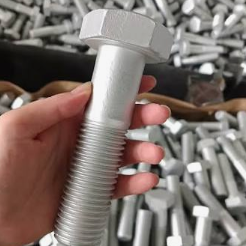
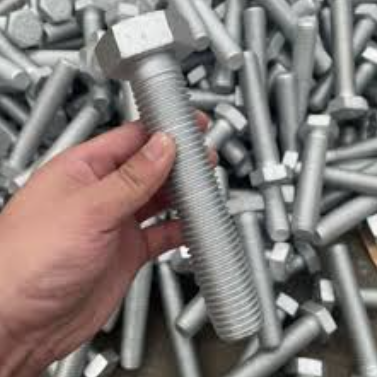
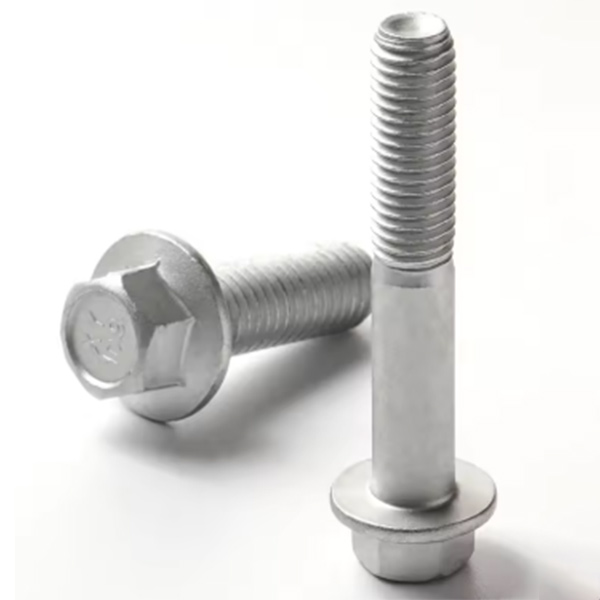
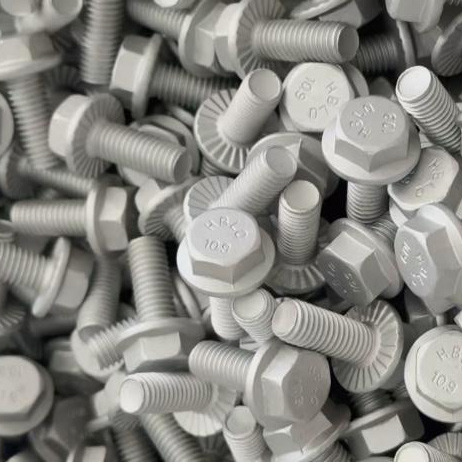
Dacromet hexagonal bolts (also called Dacromet-coated hex bolts or zinc-flake coated hexagonal fasteners) are high-performance industrial bolts engineered for exceptional anti-corrosion and anti-rust performance. These specialized bolts combine the mechanical strength of high-grade steel hex-head fasteners with the advanced protective properties of Dacromet coating technology.
In automotive, marine, construction, and heavy industry, reliable corrosion-resistant bolts are essential. Traditional zinc plating and hot-dip galvanizing often fail under aggressive salt spray, high humidity, road salts, or elevated temperatures. Dacromet-coated hexagonal bolts solve these challenges by delivering superior rust prevention while preserving precise dimensional tolerances and mechanical integrity.
This article reviews Dacromet technology applied to hexagonal bolts, covering coating composition, key advantages in anti-corrosion protection, performance comparisons, typical applications, and why Dacromet has become a preferred surface treatment for high-strength bolts worldwide.
2. What is Dacromet Coating?
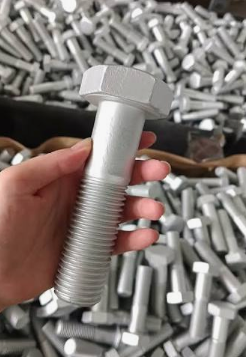
Dacromet is a proprietary zinc-aluminum flake coating system developed as an advanced alternative to conventional electroplating. The coating consists of overlapping zinc flakes and aluminum flakes in an inorganic binder. When applied to hexagonal bolts and cured at approximately 300°C, it forms a dense, multi-layered barrier that delivers outstanding anti-rust and anti-corrosion performance.
Key characteristics of Dacromet coating on bolts:
- Thin film: Typically only 4–12 μm (often 6–8 μm), preserving thread geometry and fit on precision hexagonal bolts.
- Barrier + sacrificial protection: Laminated zinc and aluminum flakes block moisture/oxygen and provide galvanic (sacrificial) protection of the steel substrate.
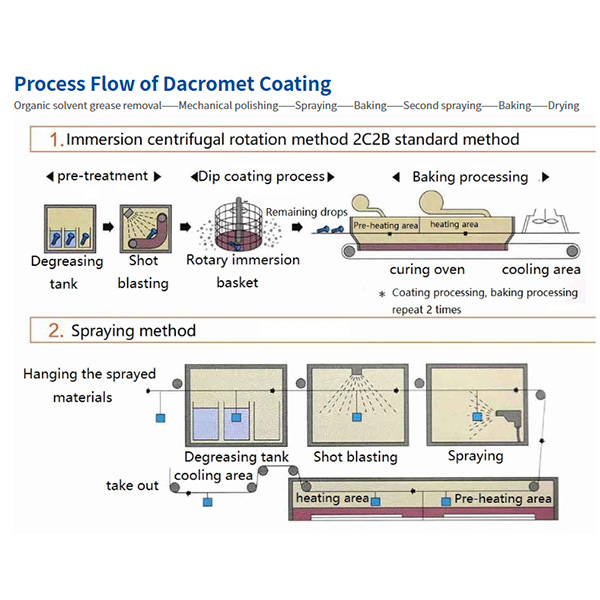
- Uniform coverage: Dip-spin or spray application ensures excellent coverage on complex geometries, including deep threads and the hexagonal head.
- Appearance: Uniform metallic silver-gray matte finish, suitable for functional and aesthetic uses.
3. Key Advantages of Dacromet Hexagonal Bolts
Exceptional Corrosion Resistance & Anti-Rust Performance
The primary advantage of Dacromet-coated hexagonal bolts is outstanding corrosion resistance and long-term anti-rust capability. Despite a thin coating of only 4–8 μm, these bolts routinely withstand neutral salt spray testing (ASTM B117 / ISO 9227) for more than 1,000 hours—and often 1,200 to over 2,000 hours—without red rust. This is typically 7–10 times better than conventional electro-galvanizing (100–300 hours) and competitive with or superior to many thicker hot-dip galvanized finishes.
The multi-layer zinc-aluminum flake structure blocks moisture, oxygen, and chlorides. Even if locally damaged, the sacrificial action of zinc continues to protect the bolt substrate, enhancing overall rust prevention. This makes Dacromet hexagonal bolts ideal for coastal, marine, automotive underbody, and industrial environments.
Zero Hydrogen Embrittlement Risk
A critical advantage for high-strength hexagonal bolts is the complete absence of hydrogen embrittlement risk. Electroplating introduces atomic hydrogen into the steel, which can cause delayed brittle fracture in grades 10.9, 12.9, and structural bolts such as ASTM A490. Dacromet is non-electrolytic and avoids aggressive acid pickling, so no hydrogen is introduced. High-strength Dacromet bolts therefore require no post-plating baking and offer higher reliability in safety-critical joints. Many automotive OEMs specify Dacromet or equivalent zinc-flake coatings for this reason.
High Temperature Resistance
Dacromet coatings maintain integrity and anti-corrosion performance at continuous temperatures up to 300°C. Conventional zinc electroplating degrades above 100–120°C, while hot-dip galvanizing has lower upper limits. This thermal stability suits Dacromet hexagonal bolts for engine compartments, exhaust systems, industrial ovens, and power-generation equipment where both clamping force and long-term rust prevention are required.
4. Performance Comparison
The table below compares Dacromet with common alternative coatings used on hexagonal bolts:
| Indicator | Dacromet | Electrogalvanizing | Hot-Dip Galvanizing |
| Coating Thickness | 4–12 μm (typ. 6–8) | 5–15 μm | 45–85 μm |
| Salt Spray (no red rust) | ≥1,000–1,200+ h | 100–300 h | 500–1,000 h |
| H₂ Embrittlement Risk | None | High (baking needed) | Medium |
| Temp. Resistance | Up to 300°C | ≤100–120°C | ≤200°C approx. |
| Thread Fit Impact | Minimal / excellent | Minimal | Significant |
| Environment | Low waste; CrVI-free options | Wastewater treatment | Zinc slag / fumes |
| Appearance | Silver-gray matte | Bright or colored | Dull gray |
Table 1. Typical performance ranges for coatings on steel hexagonal bolts. Actual results vary with process parameters and thickness.
5. Typical Applications
Thanks to superior anti-corrosion, anti-rust, heat resistance, and freedom from hydrogen embrittlement, Dacromet hexagonal bolts are widely used in:
5.1 Automotive Industry
Chassis components, suspension systems, brake assemblies, engine mounts, and underbody applications. These bolts must resist road salt, moisture, thermal cycling, and vibration. Absence of hydrogen embrittlement is critical for high-strength grade 10.9 and 12.9 fasteners in safety-related joints.
5.2 Construction, Infrastructure & Heavy Engineering
Bridges, steel structures, transmission towers, wind turbines, and heavy machinery require long-term corrosion resistance. Dacromet hexagonal bolts deliver reliable rust prevention outdoors and in coastal environments while preserving precise fit and high tensile performance.
5.3 Marine, Offshore & Chemical Environments
Salt spray, continuous humidity, and chemical exposure demand exceptional anti-corrosion performance. Dacromet-coated hexagonal bolts serve on shipboard equipment, offshore platforms, port infrastructure, and process-plant fasteners where conventional zinc coatings fail rapidly.
5.4 Other Industrial Uses
Railway components, agricultural equipment, power-generation hardware, and general industrial machinery all benefit from the combination of mechanical strength, dimensional accuracy, and durable anti-rust protection offered by Dacromet hexagonal bolts.
6. Conclusion
Dacromet hexagonal bolts provide a premium solution for applications requiring high mechanical performance together with outstanding anti-corrosion and anti-rust protection. With salt-spray resistance often exceeding 1,000 hours, zero hydrogen embrittlement risk, heat resistance to 300°C, and thin conformal coverage that preserves thread fit, Dacromet-coated bolts overcome the limitations of traditional zinc plating and frequently outperform hot-dip galvanizing in critical areas.
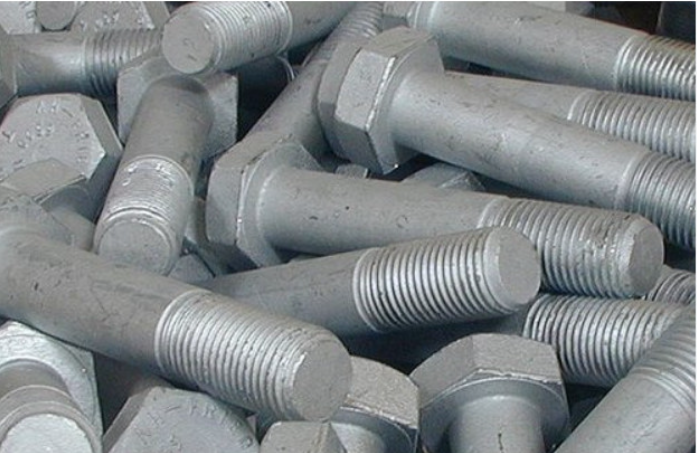
Whether used in automotive chassis, structural steelwork, marine hardware, or industrial equipment, Dacromet hexagonal bolts deliver reliable, long-lasting fastening performance in corrosive environments. Engineers seeking durable, high-strength, corrosion-resistant bolts should strongly consider Dacromet technology as a proven and preferred surface treatment.
As formulations continue to evolve toward fully chromium-free systems while maintaining or improving rust prevention performance, the role of Dacromet and related zinc-flake coatings on hexagonal bolts is expected to expand further across global industries.