- English
- Chinese
- French
- German
- Portuguese
- Spanish
- Russian
- Japanese
- Korean
- Arabic
- Irish
- Greek
- Turkish
- Italian
- Danish
- Romanian
- Indonesian
- Czech
- Afrikaans
- Swedish
- Polish
- Catalan
- Esperanto
- Hindi
- Lao
- Albanian
- Amharic
- Armenian
- Azerbaijani
- Belarusian
- Bengali
- Bosnian
- Bulgarian
- Cebuano
- Chichewa
- Corsican
- Croatian
- Dutch
- Estonian
- Filipino
- Finnish
- Frisian
- Galician
- Georgian
- Gujarati
- Haitian
- Hausa
- Hawaiian
- Hebrew
- Hmong
- Hungarian
- Icelandic
- Igbo
- Javanese
- Kannada
- Kazakh
- Khmer
- Kurdish
- Kyrgyz
- Latin
- Latvian
- Lithuanian
- Luxembou..
- Macedonian
- Malagasy
- Malay
- Malayalam
- Maltese
- Maori
- Marathi
- Mongolian
- Burmese
- Nepali
- Norwegian
- Pashto
- Persian
- Punjabi
- Serbian
- Sesotho
- Sinhala
- Slovak
- Slovenian
- Somali
- Samoan
- Scots Gaelic
- Shona
- Sindhi
- Sundanese
- Swahili
- Tajik
- Tamil
- Telugu
- Thai
- Ukrainian
- Urdu
- Uzbek
- Vietnamese
- Welsh
- Xhosa
- Yiddish
- Yoruba
- Zulu
- Kinyarwanda
- Tatar
- Oriya
- Turkmen
- Uyghur

Болты с полной и неполной резьбой: руководство по применению промышленного крепежа
2026-06-11
When sourcing bolts, screws, and fasteners for construction, machinery, or infrastructure projects, one critical specification often overlooked is the threading configuration. Should you choose a fully threaded bolt or a partially threaded (half-thread) bolt? The answer significantly impacts joint strength, assembly efficiency, and long-term durability. This article clarifies the key differences and provides practical guidance for engineers, procurement managers, and project specifiers.
Key terms covered: bolts, screws, fasteners, full thread bolts, partial thread bolts, hex bolts, stud bolts, heavy hex bolts, threaded rods, anti-corrosion fasteners, hot-dip galvanized bolts, dacromet coated bolts.
1. When to Use Full Thread Bolts
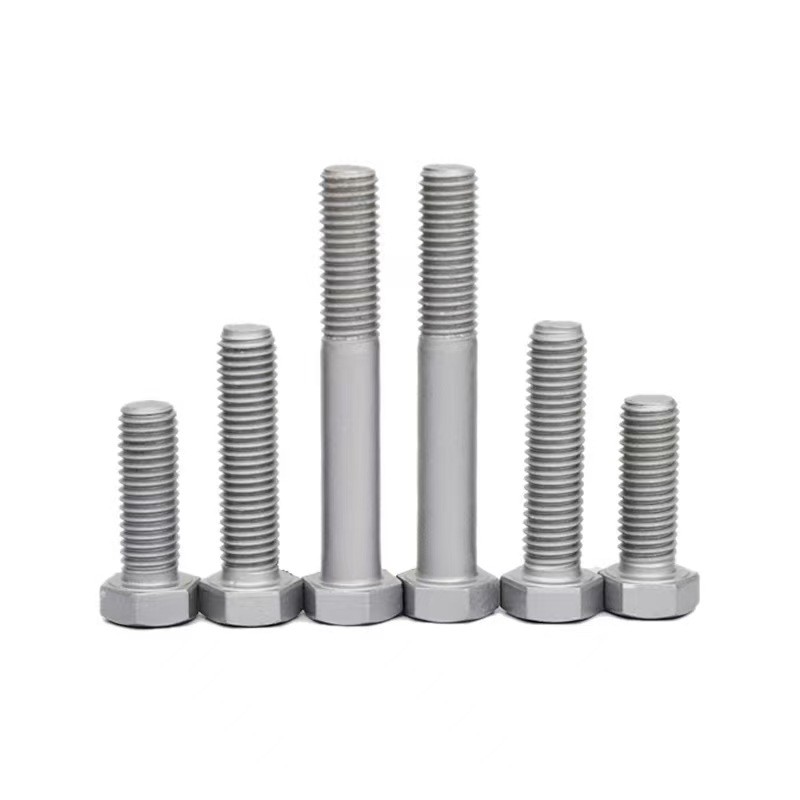
Full thread bolts excel in applications where maximum thread engagement is needed. Here are the primary scenarios:
Thin-Wall Assemblies: When clamping thin plates, sheets, or components where the total grip length is short, full threads ensure adequate engagement for proper tightening torque.
Tapped Hole Connections: When a bolt threads directly into a tapped (threaded) hole rather than using a nut, full threads provide maximum holding power within the available material depth.
Adjustment and Clamping: In fixtures, jigs, and adjustable assemblies where a bolt functions as a clamping or positioning element, full threads allow continuous adjustment along the entire length.
Shear-Dominant Joints: In connections where the bolt primarily resists shear forces rather than tensile loads, full threads perform well because the threaded cross-section engages fully with both joined members.
Small-Diameter Fasteners (< M16): For bolts and screws below M16 diameter and under 100 mm length, full threading is the manufacturing default and suits most general-purpose applications.
2. When to Use Partial Thread Bolts
Partial thread bolts are the preferred choice when joint integrity depends on precise load transfer through the bolt shank. Key application scenarios include:
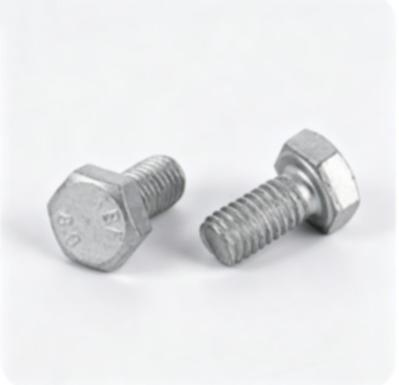
Structural Steel Connections: Heavy hex bolts (ASTM A325, A490, A193 B7) used in buildings, bridges, and towers require a smooth shank to resist shear at the joint plane. The unthreaded grip section provides a full-diameter bearing surface, critical for slip-critical connections.
High-Tension Bolting (> 100 mm Length): For bolts exceeding 100 mm, partial threading reduces stress concentration at the thread root in the shear plane. The smooth shank distributes clamping force evenly across the joint members.
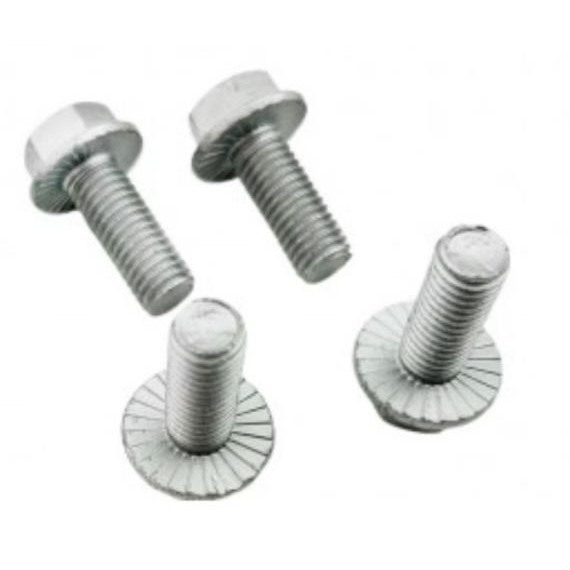
Piping and Flange Assemblies: Flange bolts (DIN 6921, ASME B18.2.1) use partial threading to maintain alignment accuracy in flange connections. The shank acts as a locating dowel, preventing relative movement between flanges under pressure cycling.
Rotating and Dynamic Loads: In machinery with vibration or cyclic loading, the unthreaded shank prevents fretting wear and reduces the risk of fatigue crack initiation at thread roots.
Anti-Corrosion Applications: For hot-dip galvanized (HDG), dacromet, or PTFE-coated bolts, the smooth shank accepts coating more uniformly than threaded sections, providing superior corrosion protection at the critical load-bearing zone.
Heavy Equipment and Mining: High-strength bolts (Grade 8.8, 10.9, 12.9) in excavators, crushers, and conveyor systems rely on partial thread design to handle combined shear and tensile loads in harsh environments.
3. Quick Comparison: Full Thread vs. Partial Thread
| Criteria | Full Thread Bolt | Partial Thread Bolt |
| Typical Length | < 100 mm (standard) | ≥ 100 mm (standard) |
| Thread Coverage | 100% of shank | 40–60% of shank |
| Shear Resistance | Lower (reduced cross-section) | Higher (full shank diameter) |
| Alignment Precision | Moderate | Excellent (shank as dowel) |
| Adjustment Range | Full length | Threaded portion only |
| Fatigue Performance | Moderate | Better (no threads in load zone) |
| Coating Uniformity | Good on threads | Excellent on smooth shank |
| Best For | Clamping, tapped holes, adjustment, small fasteners | Structural, piping, dynamic loads, heavy equipment |
. Material Grades and Surface Treatment
FUJINRUI supplies both full thread and partial thread bolts across multiple material grades:
- Grade 4.8 / 8.8 (Q235, Q355B, Q355D carbon steel) — standard structural applications
- Grade 10.9 / 12.9 (40Cr, 35CrMo alloy steel) — high-strength bolting
- Stainless Steel A2/A4 (304, 316) — corrosive environments
Anti-corrosion coating options include:
- Hot-Dip Galvanized (HDG) — heavy-duty outdoor and marine environments
- Dacromet / Geomet — superior corrosion resistance without hydrogen embrittlement risk
- PTFE / Xylan — chemical and high-temperature resistance
5. Making the Right Choice
The decision between full thread and partial thread bolts comes down to a few key factors: joint type (tapped hole vs. through-bolt), bolt length (above or below 100 mm), load direction (shear vs. tension), and environmental conditions. When in doubt, consult the relevant standard (ISO, DIN, ASTM) for your specific application, or reach out to our engineering team for technical support.
At FUJINRUI, we manufacture and export anti-corrosion fasteners — including double-end studs, hex bolts, flange bolts, nuts, and washers — in both full thread and partial thread configurations. Our products serve customers across Southeast Asia, the Middle East, Europe, and the Americas in sectors including construction, petrochemical, power generation, and heavy machinery.
Свяжитесь с компанией FUJINRUI по вопросам поставки болтов и крепежных изделий.
© 2026 FUJINRUI Fastener Co., Ltd. Все права защищены. Данная статья носит информационный характер и не является инженерной консультацией.