- English
- Chinese
- French
- German
- Portuguese
- Spanish
- Russian
- Japanese
- Korean
- Arabic
- Irish
- Greek
- Turkish
- Italian
- Danish
- Romanian
- Indonesian
- Czech
- Afrikaans
- Swedish
- Polish
- Basque
- Catalan
- Esperanto
- Hindi
- Lao
- Albanian
- Amharic
- Armenian
- Azerbaijani
- Belarusian
- Bengali
- Bosnian
- Bulgarian
- Cebuano
- Chichewa
- Corsican
- Croatian
- Dutch
- Estonian
- Filipino
- Finnish
- Frisian
- Galician
- Georgian
- Gujarati
- Hausa
- Hawaiian
- Hebrew
- Hmong
- Hungarian
- Icelandic
- Igbo
- Javanese
- Kannada
- Kazakh
- Khmer
- Kurdish
- Kyrgyz
- Latin
- Latvian
- Lithuanian
- Luxembou..
- Macedonian
- Malagasy
- Malay
- Malayalam
- Maltese
- Maori
- Marathi
- Mongolian
- Burmese
- Nepali
- Norwegian
- Pashto
- Persian
- Punjabi
- Serbian
- Sesotho
- Sinhala
- Slovak
- Slovenian
- Somali
- Samoan
- Scots Gaelic
- Shona
- Sindhi
- Sundanese
- Swahili
- Tajik
- Tamil
- Telugu
- Thai
- Ukrainian
- Urdu
- Uzbek
- Vietnamese
- Welsh
- Xhosa
- Yiddish
- Yoruba
- Zulu
- Kinyarwanda
- Tatar
- Oriya
- Turkmen
- Uyghur

Dacromet Hex Nuts-Technical Introduction
2026-08-19
содержание
1. Introduction
Hexagonal nuts (hex nuts) are among the most widely used fasteners in mechanical assemblies, construction, automotive, and industrial applications. When combined with advanced surface treatments such as Dacromet coating, they deliver exceptional corrosion resistance while maintaining precise dimensional tolerances and mechanical integrity.
1.1 What Are Hex Nuts?
A hex nut is a type of fastener with a hexagonal external shape and an internally threaded hole. The six-sided design allows efficient torque application using standard wrenches or sockets. Hex nuts are typically manufactured according to international standards such as ISO 4032 (style 1 regular nuts), DIN 934, or ASME B18.2.2, covering a wide range of metric and imperial sizes.
Key geometric features include the nominal thread diameter (d), pitch (P), width across flats (s), width across corners (e), and nut height (m). Property classes (e.g., 8, 10, 12 for steel) define mechanical strength to match corresponding bolt grades.
1.2 Overview of Dacromet Coating
Dacromet is a water-based, non-electrolytic zinc-aluminum flake coating developed in the 1970s. It consists of finely dispersed zinc and aluminum flakes suspended in an inorganic chromate (or chromium-free) binder. Applied primarily by dip-spin or spray methods and cured at approximately 280–320 °C, it forms a thin (typically 5–12 μm), uniform, silver-gray protective film.
Unlike traditional electroplating or hot-dip galvanizing, Dacromet provides superior corrosion protection without hydrogen embrittlement risk—making it especially suitable for high-strength fasteners (grade 10.9 and 12.9).
2. Dacromet Coating Technology
2.1 Composition and Structure
The coating is composed of overlapping layers of zinc and aluminum flakes bound by an inorganic matrix. This lamellar structure creates multiple physical barriers against moisture and corrosive ions, while the zinc provides sacrificial (galvanic) protection. Aluminum enhances barrier properties and heat resistance.
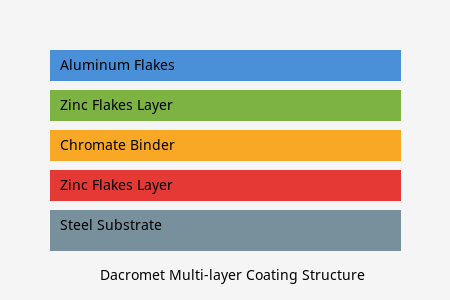
Figure 2. Simplified multi-layer structure of a Dacromet coating on steel substrate
2.2 Application Process
The typical process sequence is:
- Surface preparation – alkaline degreasing and abrasive cleaning (no acid pickling).
- Coating application – dip-spin or spray of the water-based zinc-aluminum slurry.
- Centrifuging – removal of excess coating to ensure uniform thickness.
- Curing – baking at ~300 °C for 15–30 minutes to form the dense inorganic film. Multiple coats may be applied for higher performance grades.
2.3 Key Advantages
- Outstanding corrosion resistance: 1,000–2,000+ hours salt spray (ASTM B117) to red rust – typically 5–10 times better than standard zinc plating.
- No hydrogen embrittlement: Non-electrolytic process is safe for high-strength steel (10.9 / 12.9).
- Thin coating (5–12 μm): Preserves thread fit and dimensional accuracy; no need for overtapping.
- High temperature resistance: Stable up to 300 °C continuous service.
- Uniform coverage: Excellent penetration into recesses, threads, and complex geometries via dip-spin.
- Consistent friction coefficients: Can be combined with lubricated topcoats for controlled torque-tension performance.
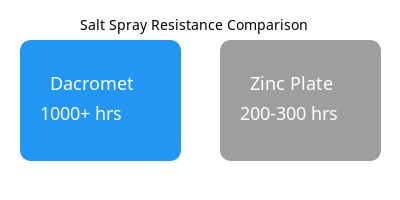
Figure 3. Illustrative comparison of salt-spray performance
2.4 Comparison with Other Coatings
| Property | Dacromet | Zinc Plating | Hot-Dip Galvanizing |
| Salt Spray (to red rust) | 1,000–2,000+ h | 200–300 h | 500–1,500 h |
| Coating Thickness | 5–12 μm | 5–15 μm | 40–85 μm |
| Hydrogen Embrittlement | None | Possible | Possible (high-strength) |
| Max. Service Temp. | ≈ 300 °C | ≈ 120 °C | ≈ 200 °C |
| Thread Fit Impact | Minimal | Low | Significant (may require overtapping) |
Table 1. Performance comparison of common fastener coatings
3. Hex Nuts – Standards, Dimensions & Strength
3.1 International Standards
The most common standards for metric hex nuts are ISO 4032 (style 1 regular nuts) and the older but still widely used DIN 934. These standards define dimensions, tolerances, and product grades (A, B, C). Property classes for steel nuts are specified in ISO 898-2 (e.g., classes 6, 8, 10, 12).
Note: DIN 934 and ISO 4032 differ slightly in across-flats dimensions for certain sizes (e.g., M10, M12, M22). Always verify compatibility when mixing standards.
3.2 Common Metric Dimensions (ISO 4032 Style 1)
| Size | Pitch P | s (max) | e (min) | m (max) | m (min) |
| M6 | 1 | 10.00 | 11.05 | 5.20 | 4.90 |
| M8 | 1.25 | 13.00 | 14.38 | 6.80 | 6.44 |
| M10 | 1.5 | 16.00 | 17.77 | 8.40 | 8.04 |
| M12 | 1.75 | 18.00 | 20.03 | 10.80 | 10.37 |
| M16 | 2 | 24.00 | 26.75 | 14.80 | 14.10 |
| M20 | 2.5 | 30.00 | 32.95 | 18.00 | 16.90 |
Table 2. Selected metric hex nut dimensions (ISO 4032, mm). s = width across flats; e = width across corners; m = nut height.
3.3 Property Classes & Matching
Nuts must be matched to bolt strength to ensure the joint fails in a controlled manner (preferably in the bolt). Common pairings under ISO 898-2:
- Bolt class 8.8 → Nut class 8 or higher
- Bolt class 10.9 → Nut class 10 or higher
- Bolt class 12.9 → Nut class 12
Dacromet coating is particularly valuable for class 10 and 12 nuts because the process introduces no hydrogen embrittlement risk that could compromise high-strength materials.
4. Applications of Dacromet Hex Nuts
Dacromet-coated hex nuts excel wherever high corrosion resistance, dimensional precision, and mechanical reliability are simultaneously required:
Automotive & Transportation
Chassis components, suspension systems, brake assemblies, engine fasteners, and underbody parts exposed to road salt and high temperatures.
Wind Energy & Infrastructure
Tower bolts and foundation fasteners for onshore and offshore wind turbines, where salt-spray exposure can exceed 2,000 hours of protection requirement.
Construction & Heavy Machinery
Structural connections, agricultural equipment, mining machinery, and outdoor installations subject to weathering and chemical exposure.
Marine & Chemical Environments
Deck hardware, offshore platforms, and process equipment where traditional coatings degrade rapidly.
4.1 Selection Guidelines
| Requirement | Recommended Solution | Notes |
| High-strength (≥10.9) | Dacromet Grade B or higher | No H-embrittlement risk |
| Outdoor / coastal | Dacromet ≥1,000 h SST | Superior to standard zinc |
| Precision threads / tight tolerance | Dacromet (thin film) | Avoids HDG thread interference |
| High temperature (>150 °C) | Dacromet | Stable to ~300 °C |
| Cost-sensitive indoor use | Electroplated zinc | Lower protection needed |
Table 3. Quick selection guide for coated hex nuts
5. Conclusion
Dacromet hex nuts combine the mechanical reliability and standardized geometry of traditional hexagonal nuts with the advanced corrosion protection of zinc-aluminum flake technology. Their thin, uniform coating preserves thread engagement and torque consistency, while delivering salt-spray performance far superior to conventional zinc plating and free from hydrogen-embrittlement concerns.
For engineers and purchasers specifying fasteners for automotive, renewable energy, infrastructure, or harsh industrial environments, Dacromet-coated hex nuts offer a proven balance of durability, precision, and long-term cost-effectiveness.
When selecting products, always confirm coating grade (A/B or equivalent), salt-spray rating, friction coefficient (if lubricated topcoat is applied), and compatibility with the mating bolt class and environmental conditions of the final application.
References & Standards: ISO 4032, ISO 898-2, DIN 934, ASTM B117, manufacturer data sheets for Dacromet / zinc-flake systems (e.g., DACROMET®, GEOMET®).