- English
- Chinese
- French
- German
- Portuguese
- Spanish
- Russian
- Japanese
- Korean
- Arabic
- Irish
- Greek
- Turkish
- Italian
- Danish
- Romanian
- Indonesian
- Czech
- Afrikaans
- Swedish
- Polish
- Basque
- Catalan
- Esperanto
- Hindi
- Lao
- Albanian
- Amharic
- Armenian
- Azerbaijani
- Belarusian
- Bengali
- Bosnian
- Bulgarian
- Cebuano
- Chichewa
- Corsican
- Croatian
- Dutch
- Estonian
- Filipino
- Finnish
- Frisian
- Galician
- Georgian
- Gujarati
- Haitian
- Hausa
- Hawaiian
- Hebrew
- Hmong
- Hungarian
- Icelandic
- Igbo
- Javanese
- Kannada
- Kazakh
- Khmer
- Kurdish
- Kyrgyz
- Latin
- Latvian
- Lithuanian
- Luxembou..
- Macedonian
- Malagasy
- Malay
- Malayalam
- Maltese
- Maori
- Marathi
- Mongolian
- Burmese
- Nepali
- Norwegian
- Pashto
- Persian
- Punjabi
- Serbian
- Sesotho
- Sinhala
- Slovak
- Slovenian
- Somali
- Scots Gaelic
- Shona
- Sindhi
- Sundanese
- Swahili
- Tajik
- Tamil
- Telugu
- Thai
- Ukrainian
- Urdu
- Uzbek
- Vietnamese
- Welsh
- Xhosa
- Yiddish
- Yoruba
- Zulu
- Kinyarwanda
- Tatar
- Oriya
- Turkmen
- Uyghur

An Introduction to Dacromet Hexagonal Bolts
2026-09-09
1. Introduction
In modern engineering and manufacturing, the reliability of mechanical connections often depends on the quality and durability of fasteners. Among the various surface treatments available for steel bolts, Dacromet coating has emerged as a leading technology for providing exceptional corrosion protection without compromising mechanical strength. Dacromet hexagonal bolts—hexagon head bolts treated with this advanced zinc-aluminum flake coating—are widely specified in industries where long-term performance under harsh environmental conditions is essential.
This article provides a comprehensive overview of Dacromet hexagonal bolts, covering the nature of the coating technology, the manufacturing process, key performance advantages, comparisons with traditional coatings, typical applications, and relevant industry standards. Understanding these aspects enables engineers, purchasers, and maintenance professionals to make informed decisions when selecting fasteners for critical applications.
2. What Is Dacromet Coating?
Dacromet (a registered trademark that has become a generic descriptor for the technology) is a non-electrolytic, inorganic zinc-flake coating system. It consists primarily of ultra-fine zinc and aluminum flakes dispersed in a water-based binder containing chromium compounds. After application and curing, the flakes form a multilayered lamellar structure that provides both barrier and sacrificial (cathodic) protection to the underlying steel substrate.
Unlike conventional electroplating or hot-dip galvanizing, the Dacromet process does not involve acid pickling or electrolytic deposition. Instead, parts are typically cleaned mechanically, immersed in or sprayed with the aqueous coating suspension (commonly using a dip-spin method), and then cured at approximately 300 °C. During curing, the binder forms a dense inorganic matrix that locks the metal flakes in place and bonds firmly to the base metal.
The resulting film is remarkably thin—usually only 4–8 μm (micrometers)—yet delivers corrosion resistance several times greater than traditional zinc coatings of comparable or greater thickness. The finished appearance is typically a uniform metallic silver-gray. Modern variants, including chrome-reduced and chrome-free systems (such as Geomet), address evolving environmental regulations while retaining the core performance benefits.
3. Hexagonal Bolts and the Role of Surface Treatment
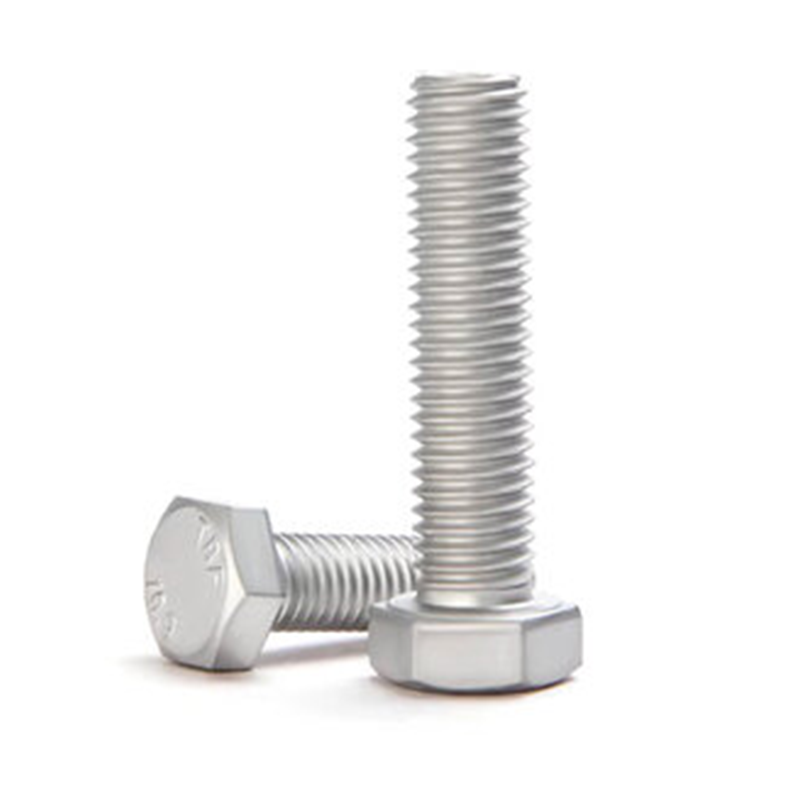
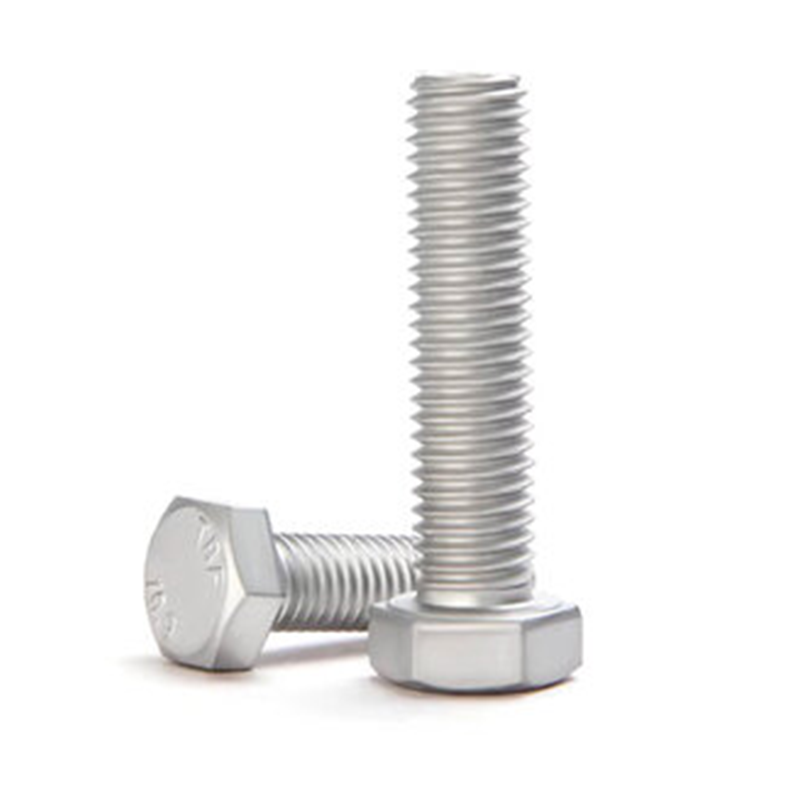
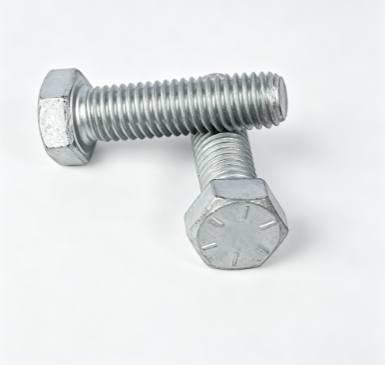
Hexagonal bolts (also called hex head bolts or hexagon head screws) feature a six-sided head that allows high torque to be applied with standard wrenches or sockets. They are among the most common fasteners used in structural, automotive, machinery, and construction applications. Grades range from low-strength (e.g., property class 4.8) to high-strength (8.8, 10.9, 12.9 and beyond), manufactured from carbon steel or alloy steel and heat-treated to achieve the required mechanical properties.
Surface treatment is critical because bare steel is susceptible to corrosion, which can reduce load-carrying capacity, seize threads, and ultimately lead to joint failure. Traditional options such as electro-galvanizing and hot-dip galvanizing have well-known limitations: hydrogen embrittlement risk in high-strength steels, relatively modest corrosion life in aggressive environments, and dimensional interference caused by thick coatings on fine threads. Dacromet coating was developed to overcome these shortcomings.
4. Key Advantages of Dacromet Hexagonal Bolts
4.1 Superior Corrosion Resistance
Despite a coating thickness of only 4–8 μm, Dacromet provides corrosion protection that is typically 7–10 times greater than conventional electro-galvanizing. In neutral salt spray testing (ASTM B117 / ISO 9227), properly applied Dacromet coatings routinely exceed 1,000 hours—and often reach 1,200 hours or more—without the appearance of red rust. Some high-performance systems achieve even longer durations. This exceptional durability stems from the multi-layer barrier of overlapping zinc and aluminum flakes combined with the passivating effect of the inorganic binder.
4.2 Absence of Hydrogen Embrittlement
One of the most significant advantages for high-strength fasteners is the complete absence of hydrogen embrittlement risk. Traditional electroplating processes involve acid cleaning and cathodic deposition, both of which can introduce atomic hydrogen into the steel lattice. This hydrogen can cause delayed brittle fracture under tensile stress—especially dangerous in property classes 10.9, 12.9 and higher. Because the Dacromet process uses neither acid pickling nor electrolysis, high-strength bolts can be coated safely while retaining their full mechanical integrity.
4.3 Excellent Heat Resistance
Dacromet coatings remain stable and protective at continuous service temperatures up to approximately 300 °C (and short-term exposure even higher). Conventional zinc electroplatings begin to degrade and lose corrosion resistance well below 100–150 °C. This thermal stability makes Dacromet hexagonal bolts ideal for engine compartments, exhaust systems, industrial furnaces, and other elevated-temperature environments.
4.4 Thin Film and Thread Compatibility
The thin, uniform coating preserves critical thread dimensions and tolerances. Unlike hot-dip galvanizing, which deposits 50–80 μm or more and often requires oversize nuts or post-coating thread chasing, Dacromet-coated bolts can be mated with standard nuts without interference. The coating also penetrates recesses, internal threads, and complex geometries that are difficult to plate uniformly by electrolytic methods.
4.5 Strong Adhesion and Recoatability
The cured Dacromet film adheres tenaciously to the steel substrate. It also provides an excellent base for subsequent organic topcoats or paints when additional color coding, friction control, or aesthetic requirements exist. Controlled-friction topcoats (such as Dacrolub or Plus systems) are frequently applied to achieve consistent torque-tension relationships during assembly.
4.6 Environmental and Process Benefits
The water-based chemistry and closed-loop application process generate significantly less hazardous waste than conventional plating lines. While classic Dacromet formulations contain hexavalent chromium, modern chromium-free or low-chromium alternatives (Geomet and similar) meet strict environmental directives such as RoHS, ELV, and REACH while delivering comparable performance.
5. Comparison with Traditional Coatings
The following table summarizes key performance differences between Dacromet and the two most common traditional zinc coatings:
| Property | Dacromet | Electro-galvanizing | Hot-dip Galvanizing |
| Coating Thickness | 4–8 μm | 5–15 μm | 50–80 μm |
| Salt Spray (no red rust) | ≥1,000–1,200 h | 100–300 h | 500–800 h |
| Hydrogen Embrittlement | None | High risk | Low–moderate |
| Heat Resistance | Up to 300 °C | ≤100 °C | ≤200 °C |
| Thread Fit Impact | Minimal | Low | Significant |
| Suitability for HS Bolts | Excellent | Limited | Moderate |
Table 1. Comparative overview of common zinc-based coatings for fasteners.
7. Conclusion
Dacromet hexagonal bolts represent a mature, high-performance solution for applications that demand long-term corrosion protection, thermal stability, and the absence of hydrogen embrittlement. Their thin yet highly effective zinc-aluminum flake coating overcomes many of the limitations associated with conventional electro-galvanizing and hot-dip galvanizing, while remaining compatible with the dimensional and assembly requirements of precision fasteners.
As industries continue to push for longer service lives, reduced maintenance, and compliance with increasingly stringent environmental regulations, the adoption of advanced zinc-flake coatings—including modern chrome-free variants—is expected to expand. For engineers and specification writers, selecting Dacromet-coated hexagonal bolts is a proven strategy for enhancing joint reliability in corrosive, high-temperature, or high-strength critical environments.
When specifying these fasteners, attention should be paid to coating grade (coating weight), optional topcoats for friction control, base material property class, and verification of compliance with the relevant international or customer standards. Proper selection and quality-controlled application ensure that the full performance potential of Dacromet technology is realized in service.