- English
- Chinese
- French
- German
- Portuguese
- Spanish
- Russian
- Japanese
- Korean
- Arabic
- Irish
- Greek
- Turkish
- Italian
- Danish
- Romanian
- Indonesian
- Czech
- Afrikaans
- Swedish
- Polish
- Basque
- Catalan
- Esperanto
- Hindi
- Lao
- Albanian
- Amharic
- Armenian
- Azerbaijani
- Belarusian
- Bengali
- Bosnian
- Bulgarian
- Cebuano
- Chichewa
- Corsican
- Croatian
- Dutch
- Estonian
- Filipino
- Finnish
- Frisian
- Galician
- Georgian
- Gujarati
- Haitian
- Hausa
- Hawaiian
- Hebrew
- Hmong
- Hungarian
- Icelandic
- Igbo
- Javanese
- Kannada
- Kazakh
- Khmer
- Kurdish
- Kyrgyz
- Latin
- Latvian
- Lithuanian
- Luxembou..
- Macedonian
- Malagasy
- Malay
- Malayalam
- Maltese
- Maori
- Marathi
- Mongolian
- Burmese
- Nepali
- Norwegian
- Pashto
- Persian
- Punjabi
- Serbian
- Sesotho
- Sinhala
- Slovak
- Slovenian
- Somali
- Scots Gaelic
- Shona
- Sindhi
- Sundanese
- Swahili
- Tajik
- Tamil
- Telugu
- Thai
- Ukrainian
- Urdu
- Uzbek
- Vietnamese
- Welsh
- Xhosa
- Yiddish
- Yoruba
- Zulu
- Kinyarwanda
- Tatar
- Oriya
- Turkmen
- Uyghur

Ruspert Self-Drilling Screws-Advanced Surface Coating Technology Meets Precision Fastening
2026-08-03
Ruspert self-drilling screws represent a convergence of two critical fastener technologies: the Ruspert high-performance anti-corrosion coating system and the self-drilling thread design. Together, they deliver a fastener solution capable of withstanding harsh environments while eliminating the need for pre-drilling, making them indispensable in construction, automotive, and infrastructure applications worldwide.
1. Ruspert Coating Technology
Ruspert is a proprietary three-layer surface treatment system designed for carbon steel fasteners. Unlike conventional electroplated zinc, Ruspert employs a water-based chemical process that forms a durable, multi-layer barrier against corrosion. The result is a distinctive blue-gray finish that combines aesthetic appeal with exceptional protective performance.
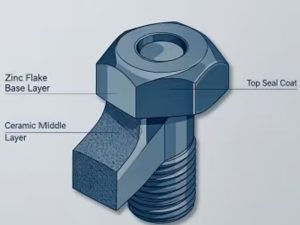
Figure 1. Three-layer structure of the Ruspert coating system
The three layers work synergistically to provide comprehensive protection:
Zinc flake base layer– provides sacrificial (cathodic) protection, corroding preferentially to shield the underlying steel substrate.
Ceramic mid-layer– acts as a chemical barrier, resisting salt spray and chemical attack far beyond conventional zinc plating.
Top seal coat– a transparent organic finish that locks in the underlying layers, enhances weathering resistance, and provides a consistent blue-gray appearance.
Table 1. Corrosion Resistance Comparison (Salt Spray Test, NSS)
| Coating Type | Salt Spray Hours | Thickness (μm) | Typical Application |
| Ruspert | ≥ 1,000 – 3,000 | 3 – 5 | Outdoor / marine |
| Dacromet | ≥ 1,000 | 6 – 8 | Industrial / outdoor |
| Zn-Ni alloy plating | ≥ 720 – 1,000 | 8 – 12 | Automotive |
| Conventional Zn plating | 96 – 240 | 5 – 8 | Indoor / general |
2. Self-Drilling Screws
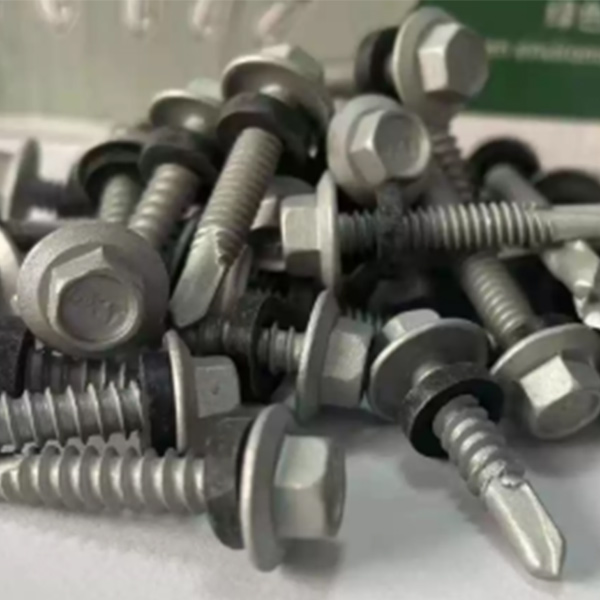
Self-drilling screws are engineered fasteners that integrate a drill-bit-like point with a threaded body. This design enables the screw to drill, tap, and fasten in a single operation, eliminating the need for pilot holes and significantly reducing installation time and labor cost.
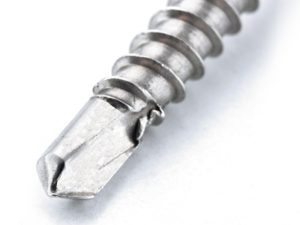
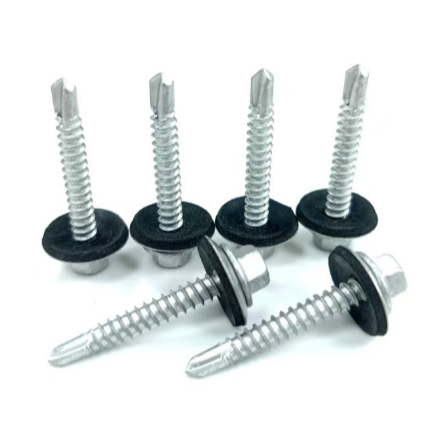
Figure 2. Ruspert-coated self-drilling screws with blue-gray finish
Key design features include:
Drill point (No.1–No.5)– determines the maximum material thickness the screw can penetrate without pre-drilling.
Wings (where applicable)– ream the hole in the top layer to prevent thread engagement before the drill point fully penetrates.
EPDM bonded washer– provides weather-tight sealing in roofing and cladding applications.
Table 2. Common Ruspert Self-Drilling Screw Specifications
| Size | Thread Dia. (mm) | Drill Point | Max Drill Capacity (mm) | Typical Application |
| #8 (4.2mm) | 4.2 | No. 1 | 3.0 | Thin sheet metal |
| #10 (4.8mm) | 4.8 | No. 2 | 4.5 | Roofing / cladding |
| #12 (5.5mm) | 5.5 | No. 3 | 6.0 | Steel framing |
| 1/4" (6.3mm) | 6.3 | No. 4–5 | 8.0 – 12.5 | Heavy structural |
3. Summary
Ruspert self-drilling screws combine the superior corrosion resistance of the Ruspert three-layer coating system (achieving 1,000–3,000 hours of salt spray protection) with the efficiency of self-drilling technology. This integration eliminates pre-drilling, reduces installation time, and ensures long-term durability in demanding environments — from coastal construction to automotive manufacturing. As infrastructure projects increasingly demand fasteners that balance performance, cost-efficiency, and longevity, Ruspert self-drilling screws have become a preferred choice for engineers and contractors worldwide.