- Chinese
- French
- German
- Portuguese
- Spanish
- Russian
- Japanese
- Korean
- Arabic
- Irish
- Greek
- Turkish
- Italian
- Danish
- Romanian
- Indonesian
- Czech
- Afrikaans
- Swedish
- Polish
- Basque
- Catalan
- Esperanto
- Hindi
- Lao
- Albanian
- Amharic
- Armenian
- Azerbaijani
- Belarusian
- Bengali
- Bosnian
- Bulgarian
- Cebuano
- Chichewa
- Corsican
- Croatian
- Dutch
- Estonian
- Filipino
- Finnish
- Frisian
- Galician
- Georgian
- Gujarati
- Haitian
- Hausa
- Hawaiian
- Hebrew
- Hmong
- Hungarian
- Icelandic
- Igbo
- Javanese
- Kannada
- Kazakh
- Khmer
- Kurdish
- Kyrgyz
- Latin
- Latvian
- Lithuanian
- Luxembou..
- Macedonian
- Malagasy
- Malay
- Malayalam
- Maltese
- Maori
- Marathi
- Mongolian
- Burmese
- Nepali
- Norwegian
- Pashto
- Persian
- Punjabi
- Serbian
- Sesotho
- Sinhala
- Slovak
- Slovenian
- Somali
- Samoan
- Scots Gaelic
- Shona
- Sindhi
- Sundanese
- Swahili
- Tajik
- Tamil
- Telugu
- Thai
- Ukrainian
- Urdu
- Uzbek
- Vietnamese
- Welsh
- Xhosa
- Yiddish
- Yoruba
- Zulu
- Kinyarwanda
- Tatar
- Oriya
- Turkmen
- Uyghur

Dacromet Flange Bolts: A Comprehensive Introduction to High-Performance Corrosion-Resistant Fasteners
2026-09-14
1. Introduction
In modern engineering and manufacturing, the reliability of bolted joints is critical to structural integrity, safety, and long-term performance. Traditional fasteners often suffer from corrosion, especially in harsh environments involving moisture, salt, chemicals, or elevated temperatures. Dacromet flange bolts address these challenges by combining a specialized zinc-aluminum flake coating with the mechanical advantages of a flange head design.
A Dacromet flange bolt is a high-performance fastener that integrates a built-in washer-like flange beneath the head with a non-electrolytic zinc-flake coating known as Dacromet (or zinc flake coating systems derived from it). This combination delivers exceptional corrosion resistance, consistent clamping force, and freedom from hydrogen embrittlement—making it particularly suitable for high-strength applications in automotive, construction, marine, energy, and industrial sectors.
2. What Is Dacromet Coating?
Dacromet is a water-based, inorganic zinc-aluminum flake coating system originally developed in the 1970s. It consists of zinc and aluminum flakes suspended in a chromate (or chromium-free) binder. The coating is applied by dip-spin, spray, or immersion methods and then cured at elevated temperatures (typically around 300°C), forming a thin, dense, multi-layered protective film.
Key characteristics of the coating include:
Thin film thickness: Typically 4–12 μm (commonly 6–8 μm), which maintains precise thread tolerances.
Barrier + sacrificial protection: Overlapping metal flakes create a physical barrier while zinc provides galvanic (sacrificial) protection.
No hydrogen embrittlement: The non-electrolytic process avoids acid pickling and electrolysis, eliminating the risk of hydrogen-induced delayed fracture in high-strength steels.
Heat resistance: Stable up to approximately 300°C continuous service temperature.
Appearance: Metallic silver-gray matte finish.
Note that “Dacromet” is a commercial brand name; similar zinc-flake systems (such as Geomet, which is chromium-free) are widely used today to meet modern environmental regulations (RoHS, REACH, ELV).
3. What Are Flange Bolts?
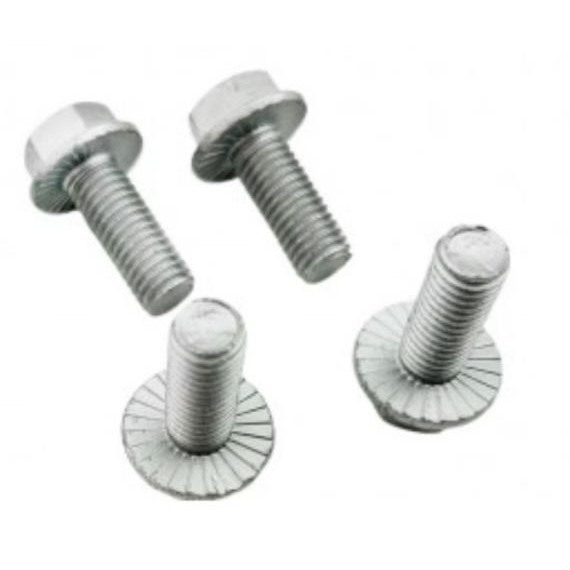
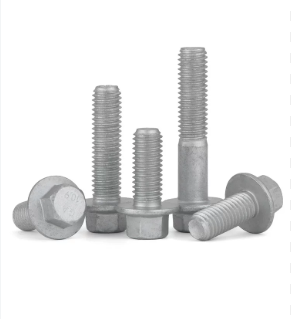
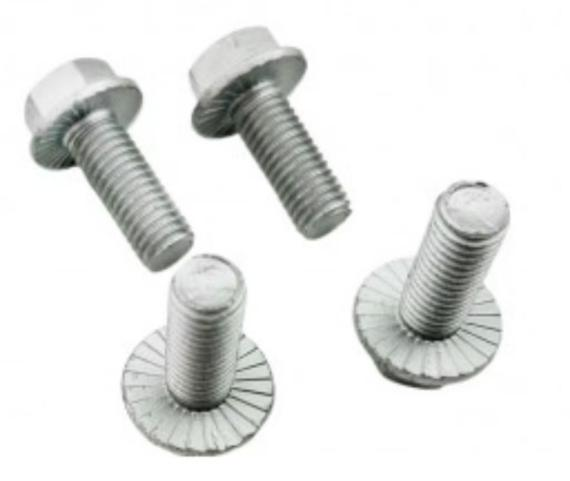
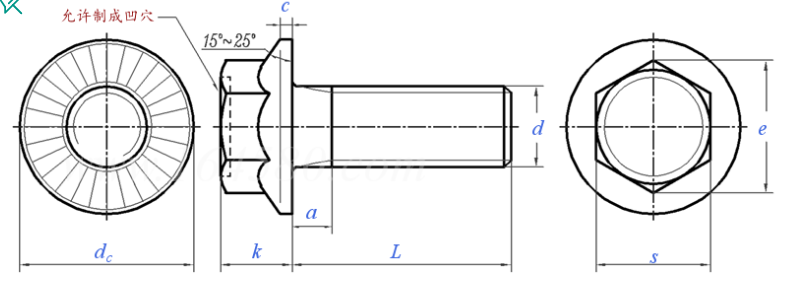
A flange bolt (also called a flanged hex head bolt or frame bolt) features an integral circular flange under the hexagonal head that functions as a built-in washer. This design distributes the clamping load over a larger surface area, reduces the risk of embedding into the joined material, improves resistance to vibration loosening, and often eliminates the need for a separate washer.
Common types include:
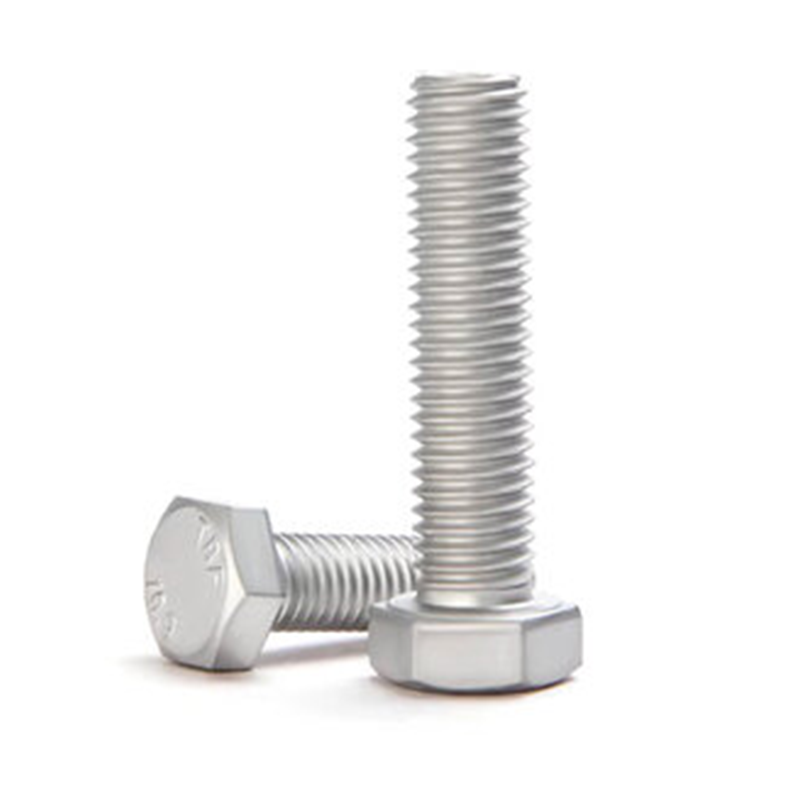
Hex flange bolts (most common)
Serrated flange bolts (with under-head serrations for anti-rotation)
Socket head or other specialty flange variants
When combined with Dacromet coating, these bolts offer both superior mechanical performance and outstanding environmental durability.
4. Comparison with Common Coatings
The following table summarizes typical performance differences:
| Property | Dacromet | Electro-Zinc | Hot-Dip Galv. | Stainless |
| Salt Spray (hrs) | 1,000–1,500+ | 100–300 | 500–1,000+ | Inherent |
| Coating Thickness | 4–12 μm | 5–15 μm | 40–100+ μm | N/A |
| H Embrittlement Risk | None | High (for ≥10.9) | Low–Medium | None |
| Max Service Temp. | ~300°C | ~100–120°C | ~200°C | High |
| Thread Fit Impact | Minimal | Low | Significant | None |
Note: Actual performance varies with coating grade, thickness, topcoat, and environmental conditions. Chromium-free zinc-flake systems (e.g., Geomet) offer similar corrosion protection while meeting stricter environmental standards.
5. Major Application Areas
Dacromet flange bolts are extensively used in chassis components, suspension systems, engine mounts, brake assemblies, exhaust systems, and body structures. They withstand road salts, thermal cycling, vibration, and high under-hood temperatures while providing reliable clamp load.
In bridges, transmission towers, steel structures, and coastal facilities, these bolts offer long-term protection against atmospheric corrosion and reduce maintenance frequency.
Offshore wind turbine foundations, solar mounting systems, shipbuilding, and port equipment benefit from the high salt-spray resistance and ability to coat complex geometries uniformly.
Equipment exposed to fertilizers, chemicals, moisture, and abrasion—such as agricultural machinery, pumps, valves, and process equipment—commonly specifies Dacromet-coated flange fasteners for extended service life.
6. Common Grades, Standards, and Selection Guidance
Property classes: Dacromet flange bolts are available in property classes 4.8, 8.8, 10.9, and 12.9 (metric), as well as Grade 5 and Grade 8 (imperial). High-strength grades (10.9/12.9) particularly benefit from the absence of hydrogen embrittlement risk.
Dimensional standards: Common references include ISO metric flange bolt standards, DIN, GB (Chinese), and ASME/ANSI for inch series.
Coating specifications: Performance is often specified by minimum coating weight (e.g., Grade A ≈ 24 g/m², Grade B ≈ 36 g/m²) and salt-spray requirements. Topcoats may be added for improved lubricity, color, or additional barrier protection.
Selection tips: Match the coating system to the corrosion category of the environment (e.g., C3–C5 per ISO 12944). For high-strength structural joints, confirm torque-tension data with the specific coating and topcoat. Prefer chromium-free systems when environmental compliance is required.
7. Installation and Practical Considerations
Handle with care: Although the coating has good adhesion, avoid severe mechanical damage during handling and installation.
Torque control: Use the friction coefficients provided by the coating supplier. Lubricated Dacromet systems produce more consistent clamp loads than unlubricated zinc coatings.
Compatibility: Dacromet is generally compatible with most gasket and sealing materials and can be over-painted if required.
Inspection: Visual inspection for coating continuity and adhesion testing (where specified) should be part of quality control.
8. Conclusion
Dacromet flange bolts represent a mature, high-performance fastening solution that successfully balances outstanding corrosion protection, mechanical reliability, and dimensional precision. By eliminating hydrogen embrittlement risks while delivering salt-spray performance far superior to conventional zinc plating, they have become a preferred choice for demanding applications across automotive, energy, construction, and industrial sectors.
As environmental regulations continue to drive the adoption of chromium-free zinc-flake systems, the technology continues to evolve while retaining its core advantages. When specifying fasteners for corrosive or high-temperature environments—particularly where high-strength grades are required—Dacromet (or equivalent zinc-flake) coated flange bolts should be strongly considered as a proven and cost-effective solution over the service life of the assembly.
Engineers and purchasers are encouraged to consult coating suppliers for detailed technical data sheets, friction coefficients, and salt-spray test reports specific to the chosen system and application requirements.