- English
- Chinese
- French
- German
- Portuguese
- Spanish
- Russian
- Japanese
- Korean
- Arabic
- Irish
- Greek
- Turkish
- Italian
- Danish
- Romanian
- Indonesian
- Czech
- Afrikaans
- Swedish
- Polish
- Catalan
- Esperanto
- Hindi
- Lao
- Albanian
- Amharic
- Armenian
- Azerbaijani
- Belarusian
- Bengali
- Bosnian
- Bulgarian
- Cebuano
- Chichewa
- Corsican
- Croatian
- Dutch
- Estonian
- Filipino
- Finnish
- Frisian
- Galician
- Georgian
- Gujarati
- Haitian
- Hausa
- Hawaiian
- Hebrew
- Hmong
- Hungarian
- Icelandic
- Igbo
- Javanese
- Kannada
- Kazakh
- Khmer
- Kurdish
- Kyrgyz
- Latin
- Latvian
- Lithuanian
- Luxembou..
- Macedonian
- Malagasy
- Malay
- Malayalam
- Maltese
- Maori
- Marathi
- Mongolian
- Burmese
- Nepali
- Norwegian
- Pashto
- Persian
- Punjabi
- Serbian
- Sesotho
- Sinhala
- Slovak
- Slovenian
- Somali
- Samoan
- Scots Gaelic
- Shona
- Sindhi
- Sundanese
- Swahili
- Tajik
- Tamil
- Telugu
- Thai
- Ukrainian
- Urdu
- Uzbek
- Vietnamese
- Welsh
- Xhosa
- Yiddish
- Yoruba
- Zulu
- Kinyarwanda
- Tatar
- Oriya
- Turkmen
- Uyghur

RUSPERT Self-Drilling Screws
2026-11-25
Q1: What is a RUSPERT Self-Drilling Screw?
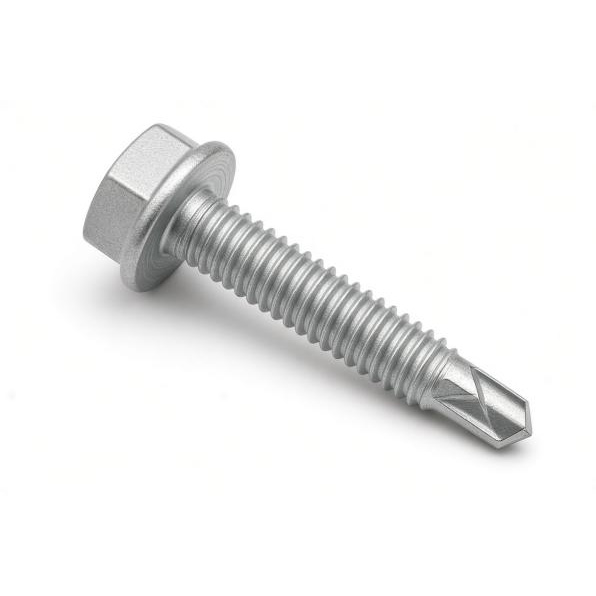
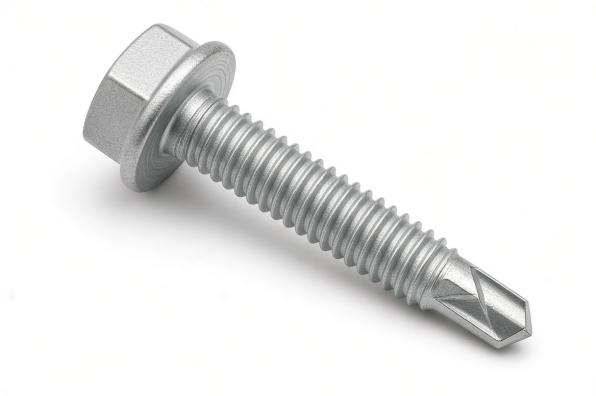
A: A RUSPERT self-drilling screw (also called a drill-point or TEK screw) is a high-performance fastener that drills its own pilot hole and forms mating threads in one operation. It features a hardened drill tip capable of penetrating steel and aluminum without pre-drilling. The key differentiator is the proprietary RUSPERT multi-layer coating that delivers exceptional rust resistance and long-term durability in outdoor, coastal, and industrial environments. Unlike ordinary zinc-plated screws that quickly develop red rust, RUSPERT-coated screws maintain both structural integrity and appearance for years.
Q2: How does the RUSPERT coating provide superior anti-corrosion protection?
A: RUSPERT is a three-layer coating system engineered for outstanding corrosion resistance:
1.Metallic Zinc Base Layer — Sacrificial (cathodic) protection; zinc corrodes preferentially to shield the steel substrate from rust.
2.Chemical Conversion Coating — Enhances adhesion between zinc and topcoat while improving passivation and overall anti-rust performance.
3.Baked Ceramic (Rustproof) Topcoat — Hard, inert barrier that resists moisture, salt, chemicals and abrasion; also minimizes galvanic (contact) corrosion with dissimilar metals.
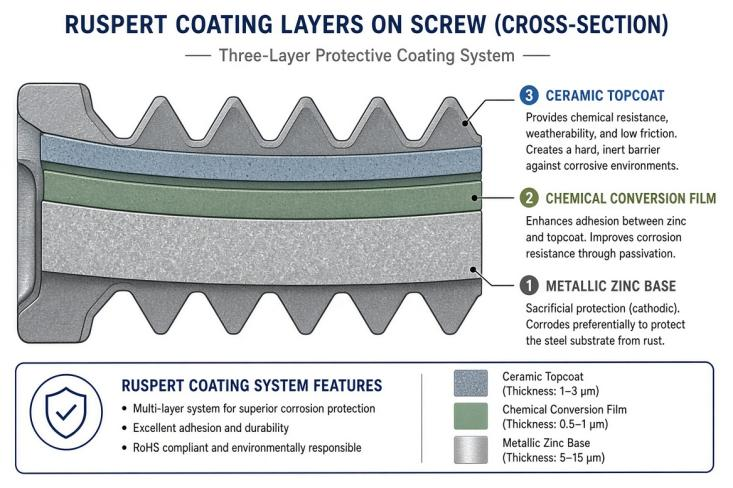
This architecture enables 500 / 1,000 / 1,500 hours of neutral salt spray resistance (ASTM B117) — far exceeding standard zinc plating (72–240 hours). The coating also performs well in Kesternich (acid-rain) tests and is highly compatible with treated timber preservatives that rapidly attack ordinary coatings.
Q3: How does RUSPERT compare with zinc plating and Dacromet?
A: RUSPERT offers clear advantages in corrosion resistance, contact corrosion protection, treated-timber compatibility and abrasion resistance:
| Performance Aspect | Zinc Plating | Dacromet | RUSPERT |
| Salt Spray Resistance | 72–240 hrs | 500–1,000 hrs | 500–1,500 hrs |
| Contact Corrosion Resistance | Low | Moderate | Excellent |
| Treated Timber Compatibility | Poor | Good | Excellent |
| Hydrogen Embrittlement Risk | High | Low | None |
| Abrasion / Damage Resistance | Low | Moderate | High (ceramic) |
| Processing Temperature | Low | Higher | < 200°C (strength retained) |
Table 1: Comparative Performance of Common Screw Coatings
Q4: Where are RUSPERT self-drilling screws typically used?
A: Their combination of self-drilling speed and outstanding anti-corrosion performance makes them ideal for:
- Roofing & Cladding — Metal roof sheets, sandwich panels and façades in coastal or industrial zones.
- Steel Construction — Light-gauge framing, purlins and secondary steel members.
- Timber-to-Metal — Decking, fencing and outdoor structures fixing treated timber to steel substructures.
- HVAC & Industrial Equipment — Assemblies exposed to humidity or mild chemical atmospheres.
- Marine & Coastal Projects — Any application requiring Class 3 or Class 4 corrosion protection.
Q5: What key specifications should I consider when selecting RUSPERT screws?
A: Important parameters include material, coating grade, geometry and compliance standards:
| Parameter | Typical Options / Notes |
| Material | Case-hardened carbon steel (C1022 / 10B21); bi-metal versions available |
| Coating Grade | R500 / R1000 / R1500 (neutral salt spray hours before red rust) |
| Diameter Range | #6 (3.5 mm) to #14 (6.3 mm) and metric equivalents |
| Length Range | 13 mm to 200+ mm depending on application thickness |
| Head Styles | Hex flange / hex washer, countersunk, pan, wafer, etc. |
| Drive Types | Hex, Phillips, Torx (TX), Square |
| Drill Point & Capacity | #1–#5 points; typical drilling capacity 0.8–6 mm steel (bi-metal up to 8–12.5 mm) |
| Standards | ASTM B117, ASTM B695, DIN 50018/50021, AS 3566.2 Class 3/4 |
Table 2: Key Specification Parameters for RUSPERT Self-Drilling Screws
Q6: How does RUSPERT perform in standardized corrosion tests?
A: Independent laboratory results confirm excellent anti-rust performance:
- Neutral Salt Spray (ASTM B117): R500 ≥ 500 h; R1000 ≥ 1,000 h; R1500 ≥ 1,500 h before red rust.
- Kesternich Test (DIN 50018): Typically 12–20 cycles of SO₂ exposure for R1000/R1500 grades.
- AS 3566.2: R1000 ≈ Class 3 (moderate marine/industrial); R1500 approaches Class 4 (severe marine).
Q7: What quality certifications and compliance should I look for?
A: Reputable manufacturers provide:
- Salt-spray test reports to ASTM B117 confirming claimed hours of protection.
- Compliance with AS 3566.2 for Australian/New Zealand building applications.
- RoHS / REACH environmental compliance (no hexavalent chromium).
- Post-coating mechanical verification (tensile, hardness, torsion) to confirm the low-temperature process has not compromised strength.
Q8: Summary — Why specify RUSPERT self-drilling screws?
A: RUSPERT self-drilling screws combine the installation speed of a drill-point fastener with industry-leading anti-corrosion technology. The three-layer coating system delivers outstanding rust resistance, excellent adhesion, contact-corrosion immunity and compatibility with treated timber — all while preserving the mechanical strength of the hardened steel substrate.
Whether fastening metal roofing in a coastal environment, securing decking to steel joists, or assembling outdoor structures exposed to industrial atmospheres, RUSPERT-coated screws provide a cost-effective, long-lasting and reliable fastening solution that minimizes maintenance and maximizes service life. Selecting the appropriate coating grade (R500 / R1000 / R1500), head style and drill point for the application ensures both structural performance and exceptional corrosion protection in a single, easy-to-install fastener.